

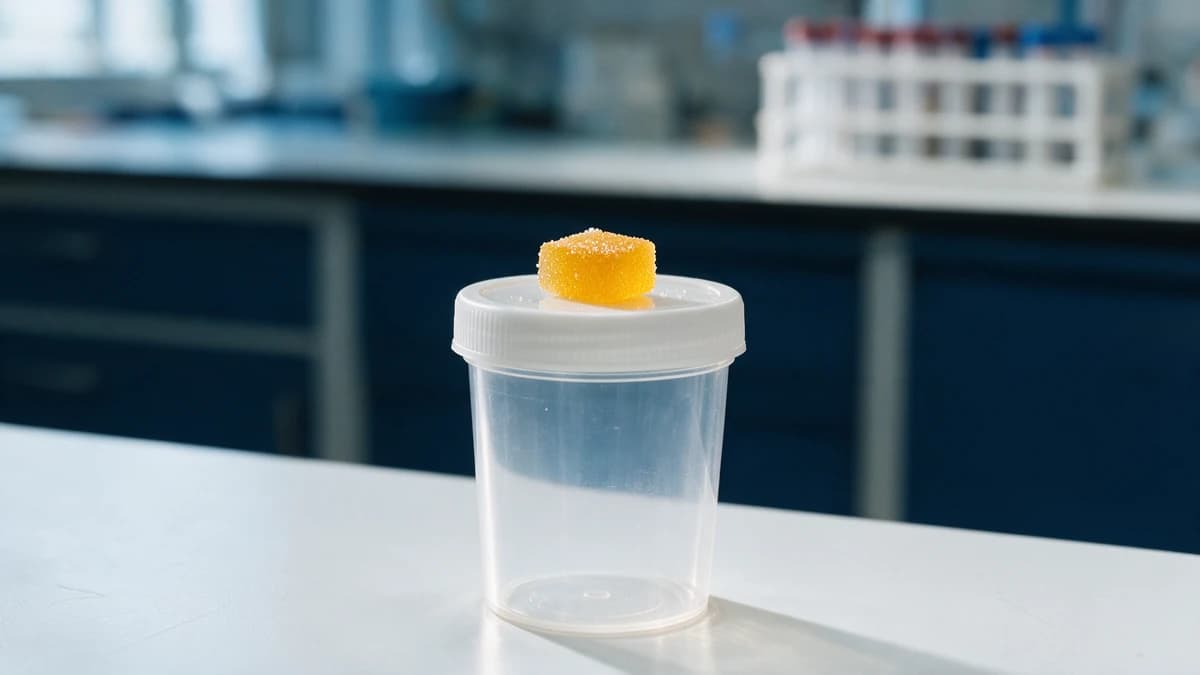
A drug test never sees your gummy. It sees a number: how many nanograms, or billionths of a gram, of one compound sit in each milliliter of your urine. One line in a federal rule decides whether that number makes you positive, and that line makes no exception for hemp.
Why do Delta-9 gummies show up on a drug test?
Delta-9 gummies show up on a drug test because your liver turns Delta-9 THC into THC-COOH, and THC-COOH is the compound a urine test hunts for. The test never asks where your THC came from. It measures that one compound in nanograms per milliliter (ng/mL) of urine, then holds the number up against a federal cutoff.
THC-COOH is the main breakdown product of THC, and it has no psychoactive effect of its own. Your liver first turns Delta-9 THC into 11-hydroxy-THC, which is still active, and then into THC-COOH. About 65% of that THC-COOH leaves your body in stool and about 25% in urine, a 2024 review in The Permanente Journal reports. A workplace test measures the share that reaches your urine.
Urine carries most of the testing load. In its 2020 hair-testing proposal, the Department of Health and Human Services (HHS) projected that 89% of federal agency drug tests would use urine. Oral fluid would take about 10% and hair about 1%. The line a sample must cross isn't arbitrary. A scientific advisory panel set the 15 ng/mL confirmation cutoff "to distinguish drug use from environmental exposure," the American College of Medical Toxicology (ACMT) explained in a 2020 position statement.
Five federal steps stand between the cup you hand over and the result your employer hears, and hemp gets no exit at any of them.
How does a workplace drug test work, step by step?
A federal workplace drug test runs in five steps: a screen, a confirmation, a doctor's review, your explanation and a verdict. The Department of Transportation (DOT) spells out each one in its testing rule, 49 CFR Part 40. The path stays the same whether the THC in your sample came from a hemp gummy or a marijuana brownie.
- The screen. The lab runs an initial test, usually an immunoassay, and reports anything under 50 ng/mL of marijuana metabolite as negative (49 CFR 40.85).
- The confirmation. A result at 50 or above goes to a second, more specific test on a separate portion of the same sample. That test identifies and measures the exact compound, and 15 ng/mL or more makes the result a confirmed positive.
- The doctor. A Medical Review Officer (MRO) receives the confirmed result. The MRO must be a licensed physician and must try to talk with you directly, in person or by phone, before verifying it (49 CFR 40.131).
- Your explanation. The MRO gives you the chance to offer a legitimate medical explanation, such as a valid prescription, and the burden of proof sits with you (49 CFR 40.137).
- The verdict. With no legitimate explanation, the MRO verifies the test as positive, and a DOT employer must remove you from safety-sensitive work at once (49 CFR 40.23).
Say you drive a school bus, and your random test comes back over both lines. The THC came from hemp Delta-9 gummies, so that's what you tell the MRO. The rule, 49 CFR 40.151, answered you before the phone rang. An MRO "must not accept an assertion of consumption or other use of a hemp" product as grounds to call a marijuana test negative. Your employer gets a verified positive, and you come off your route.
Can a drug test tell hemp Delta-9 from marijuana?
No. Delta-9 THC from hemp is the same molecule as Delta-9 THC from marijuana, and your body turns both into THC-COOH. The ACMT statement says test results "do not identify route of exposure, source of exposure, specific timing of exposure, dose." The lab can't see where your THC came from, when you took it or how much you took.
Think of a smoke detector. It reacts to smoke, and it can't tell a birthday candle from a burning pan. A drug test reacts to THC-COOH the same way, whether the THC started in a hemp gummy or a marijuana brownie. The molecule carries no tag that names the plant it came from.
Low-THC hemp oils get no pass either. The ACMT says they "could result in a positive immunoassay drug test," which is the screening step. That result turns on "the amount of THC in the particular product and the aggregate amount consumed." That means how strong the product is, and how much of it you take in total.
CBD works differently. The ACMT says CBD "is not metabolized to THC-COOH," so pure CBD won't trip a THC screen. Delta-9 gummies are a different product, because Delta-9 THC is the very compound your body turns into THC-COOH.
Can one Delta-9 gummy show up on a drug test?
Yes. Across two Johns Hopkins studies, published in 2018 and 2022, a single 10 mg dose of THC brought 26 of 27 people who rarely use cannabis to the federal 15 ng/mL confirmation level. Both studies used brownies instead of gummies, but Delta-9 THC is the same molecule in either one.
In the 2018 study in the Journal of Analytical Toxicology, six adults each ate a 10 mg THC brownie. None had used cannabis in at least three months, and all six reached the 15 ng/mL confirmation level. The table below tracks what that one dose did in their urine.
| What one 10 mg THC edible did (2018 study, 6 adults) | Average | Range across people |
|---|---|---|
| First positive at (15 ng/mL or more) | 4.2 hours | 3 to 5 hours |
| Peak THC-COOH in urine | 106.8 ng/mL, at about 8 hours | 33.8 to 277.9 ng/mL, at 4 to 17 hours |
| Last positive at (15 ng/mL or more) | 44.7 hours | 28 to 72 hours |
The 2022 study in the same journal gave 21 people who rarely use cannabis a 10 mg THC brownie and collected their urine for 8 hours. Within that window, 20 of the 21 reached the 15 ng/mL confirmation level. Only one person stayed under the line.
We draw one conclusion from those two studies. One 10 mg dose of Delta-9 THC is enough to cross the federal line in almost everyone tested, even people who seldom touch THC. Each Pure Roots gummy gives you 10 mg of Delta-9 THC, the same dose the researchers used.
Does a positive drug test mean you were high?
No. A positive urine test shows THC entered your body before you gave the sample, not that you were high when you gave it. Neither HHS workplace testing nor clinical urine testing "can be used in isolation to establish impairment or intoxication," the ACMT states. A positive proves exposure, not impairment.
THC's effects and THC-COOH's detection window run on different clocks. The effects of THC last several hours, but "the detection interval of THC-COOH is much longer than the duration of action of THC," the ACMT notes. A blood test doesn't settle the impairment question either. Unlike blood alcohol, the amount of THC in your blood doesn't track how impaired you are, the 2024 Permanente review reports.
At a DOT job, the gap between exposure and impairment changes nothing. The rule acts on the verified result, not on how you felt when you gave the sample.
How long can each type of test find THC?
A urine test reaches back days to weeks and a hair test about one to two months, while blood and saliva tests have the shortest windows of the four. Each sample type has its own window, and your dose, how often you use and your own body all move it. Here's what single oral doses did in controlled studies, alongside the HHS hair figures:
| Test | What it looks for | How long it can find THC |
|---|---|---|
| Urine | THC-COOH | Last positive at 28 to 72 hours after one 10 mg edible, in people who rarely use (2018). Longer with regular use (below). |
| Blood | THC, then THC-COOH | THC itself for up to 5 hours after 10 mg. THC-COOH on a screening test for 8 to 54 hours (2017). |
| Saliva | THC left in the mouth | About 1 to 3 hours after 10 mg, and up to 22 hours after 50 mg (2017). |
| Hair | THC-COOH | Drugs take 5 to 7 days to show up in hair. A 0.5 to 1 inch sample covers about 30 to 60 days (HHS proposal, 2020). |
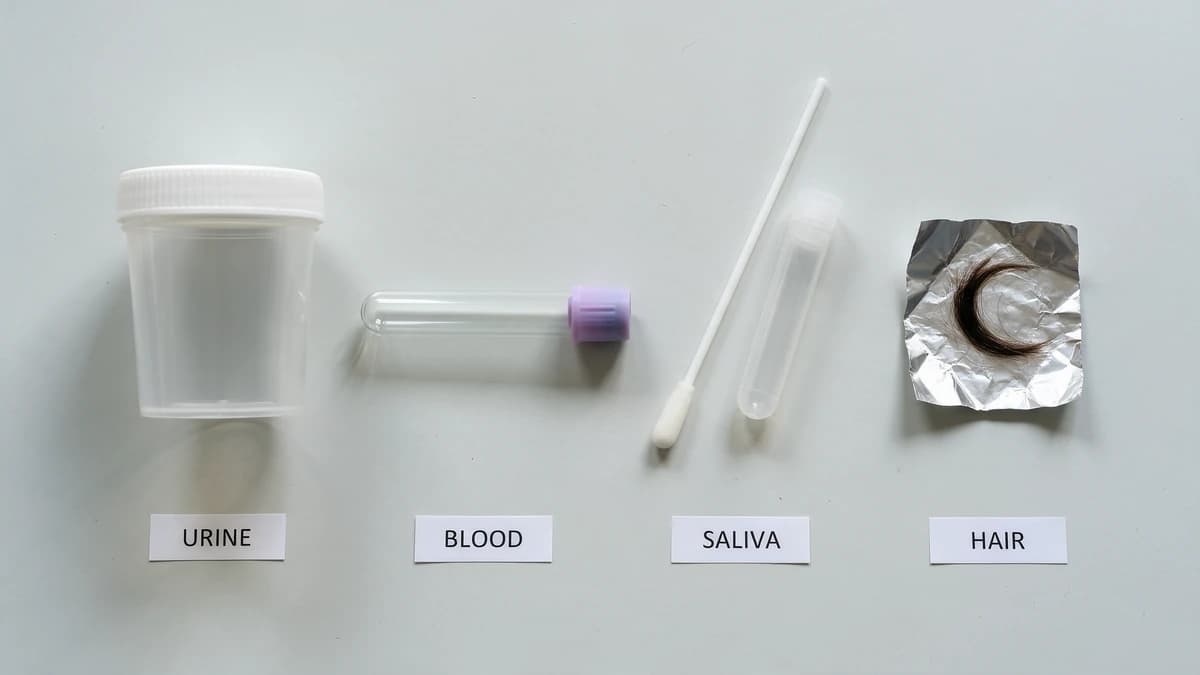
How often you use moves the urine window most. A 2017 Mayo Clinic review, reproduced in the 2024 Permanente review, puts that window at about 3 days for people who use two or three times a week. For long-term heavy daily use, the same review puts it at more than 30 days. Our post on how long Delta-9 edibles stay in your system breaks down every window.
THC lingers because it builds up in body fat and seeps back out slowly. THC's terminal half-life runs 25 to 36 hours, the 2024 Permanente review reports. A half-life is the time your body needs to clear half of what's left, and the terminal one covers that slow final phase. As a result, your body keeps making THC-COOH long after the effects fade.
Is "hemp-derived" an excuse at work or in the military?
No. At DOT-regulated jobs, the testing rule tells the reviewing doctor to reject hemp as an explanation, and the military bans hemp products for service members outright. For DOT workers and service members, a positive from a hemp gummy counts the same as one from marijuana.
DOT-regulated jobs
The Department of Transportation tests pilots, school bus drivers, truck drivers, train engineers and other safety-sensitive workers. Its February 2020 notice on CBD products states the rule plainly: "The Department of Transportation requires testing for marijuana and not CBD." That marijuana test measures THC-COOH, and your body makes THC-COOH from hemp Delta-9 too.
DOT's CBD notice closes the CBD excuse as well: "CBD use is not a legitimate medical explanation for a laboratory-confirmed marijuana positive result." MROs will verify a confirmed test as positive "even if an employee claims they only used a CBD product." The notice also warns that a CBD product can hold more THC than its label states.
The military
The U.S. military bans hemp products outright. A Department of Defense memo set the policy in February 2020, effective March 1, for active duty and reserve members, Operation Supplement Safety (OPSS) reports. OPSS is a DoD program at the Uniformed Services University. Its page, updated in 2022, sums the policy up: "All products containing hemp are prohibited for use by Service Members."
The Navy's 2020 order, ALNAV 074/20, bars Sailors and Marines from using "any product made or derived from hemp," including CBD, "regardless of the product's THC concentration, claimed or actual." The Army and Air Force rules ban hemp products too, OPSS reports. For a service member, the THC number on a label changes nothing.
What can other employers do after a positive drug test?
Outside DOT rules, other employers act on a positive drug test under their own written policy, within any limits your state sets. The ACMT notes that the federal testing program is "mandated for use in select industries and voluntarily adopted by other employers." That means the same 50 and 15 ng/mL cutoffs can follow you into a job with no DOT tie.
New York shows how a state limit works. Its Labor Law, section 201-d, bars employers from firing or refusing to hire a worker over their "legal use of consumable products, including cannabis in accordance with state law." That protection covers only legal use, off the clock, off the premises and without the employer's equipment.
Section 201-d still lets an employer act when a state or federal mandate requires it, or when a federal contract or federal funding depends on it. It also lets an employer act when a worker shows "specific articulable symptoms" of impairment on the job. A state protection like New York's limits what an employer does about legal off-duty use. It never changes the result. We recommend reading your employer's written drug policy before you count on any state rule.
Do Pure Roots Delta-9 gummies show up on a drug test?
Yes. Pure Roots Delta-9 gummies show up on a drug test like any other Delta-9 THC, and we'd rather you hear that from us than from a lab report. Our Delta-9 gummies are made with USDA Certified Organic live rosin. Organic farming changes how the hemp is grown, but it doesn't change the molecule a lab finds.
We grow our own USDA Certified Organic hemp on our North Carolina farm, where Ben Cerullo, our founder and master grower, runs the organic operations. Anyone can look up our certification, NOP ID 5561006795, in the USDA Organic Integrity Database. Our advice: treat "hemp-derived" on any label as a fact about the farm, never as a fact about the drug test.
Our beginner's guide to live rosin gummies covers how that rosin is made. Our 20-count Delta-9 gummies come in four flavors: Tangerine Dream, Strawberry Frost, Pineapple Paradise and Blueberry Blast. Our gummies are for adults 21 and over. Don't drive after one, and keep the pouch away from children and pets.
Frequently Asked Questions
Do hemp Delta-9 gummies test differently from marijuana edibles?
No. Federal testing rules set no separate cutoff for hemp. The cutoff table in 49 CFR 40.85 has one line for marijuana metabolites, and THC-COOH from a hemp gummy goes up against that same line.
How soon after one gummy can I test positive?
Within hours. In the 2018 Johns Hopkins study, urine first reached the 15 ng/mL confirmation level an average of 4.2 hours after a single 10 mg THC edible.
Can a test show how much I took?
No. In the 2018 study, six people ate the same 10 mg edible, and their peak THC-COOH levels ranged from 33.8 to 277.9 ng/mL, more than eight times apart.
Will CBD-only products show up?
Only if they contain THC, and some products sold as CBD do. The ACMT (2020) says those products "could result in a positive test for THC-COOH" when the THC in them is high enough.
Does a medical marijuana card protect you on a DOT drug test?
No. Under 49 CFR 40.151, an MRO must not verify a DOT test as negative because a doctor recommended marijuana, even under a state medical marijuana program. The rule covers a recommendation for any Schedule I drug.
Sources
- Connors NJ, Kosnett MJ, Kulig K, Nelson LS, Stolbach A (American College of Medical Toxicology), "ACMT Position Statement: Interpretation of Urine for Tetrahydrocannabinol Metabolites," Journal of Medical Toxicology 16(2):240-242, 2020. pmc.ncbi.nlm.nih.gov
- U.S. Department of Transportation, 49 CFR 40.85, "What are the cutoff concentrations for urine drug tests?" Electronic Code of Federal Regulations, as amended at 88 FR 27643, 2023. ecfr.gov
- U.S. Department of Health and Human Services, SAMHSA, "Mandatory Guidelines for Federal Workplace Drug Testing Programs" (proposed hair guidelines), Federal Register 85 FR 56108, September 10, 2020. govinfo.gov
- Schlienz NJ, Cone EJ, Herrmann ES, et al., "Pharmacokinetic Characterization of 11-nor-9-carboxy-Δ9-tetrahydrocannabinol in Urine Following Acute Oral Cannabis Ingestion in Healthy Adults," Journal of Analytical Toxicology 42(4):232-247, 2018. pmc.ncbi.nlm.nih.gov
- Sholler DJ, Zamarripa CA, Spindle TR, et al., "Urinary Excretion Profile of Cannabinoid Analytes Following Acute Administration of Oral and Vaporized Cannabis in Infrequent Cannabis Users," Journal of Analytical Toxicology 46(8):882-890, 2022. pmc.ncbi.nlm.nih.gov
- Vandrey R, Herrmann ES, Mitchell JM, et al., "Pharmacokinetic Profile of Oral Cannabis in Humans: Blood and Oral Fluid Disposition and Relation to Pharmacodynamic Outcomes," Journal of Analytical Toxicology 41(2):83-99, 2017. pmc.ncbi.nlm.nih.gov
- Radparvar S, "Clinical Evaluation of the Cannabis-Using Patient: A Moving Target," The Permanente Journal 28(4):77-86, 2024. pmc.ncbi.nlm.nih.gov
- Moeller KE, Kissack JC, Atayee RS, Lee KC, "Clinical Interpretation of Urine Drug Tests: What Clinicians Need to Know About Urine Drug Screens," Mayo Clinic Proceedings 92(5):774-796, 2017. pubmed.ncbi.nlm.nih.gov
- U.S. Department of Transportation, Office of Drug and Alcohol Policy and Compliance, "DOT 'CBD' Notice," February 18, 2020. transportation.gov and DOT bulletin copy content.govdelivery.com
- Operation Supplement Safety, Uniformed Services University / Department of Defense, "Hemp and DoD Policy," updated November 14, 2022. opss.org
- U.S. Department of Transportation, 49 CFR 40.3, "What do the terms used in this part mean?" Electronic Code of Federal Regulations. ecfr.gov
- U.S. Department of Transportation, 49 CFR 40.23, "What actions do employers take after receiving verified test results?" Electronic Code of Federal Regulations, as amended at 88 FR 27637, 2023. ecfr.gov
- U.S. Department of Transportation, 49 CFR 40.131, "How does the MRO or DER notify an employee of the verification process after receiving laboratory confirmed non-negative drug test results?" Electronic Code of Federal Regulations. ecfr.gov
- U.S. Department of Transportation, 49 CFR 40.137, "On what basis does the MRO verify test results involving marijuana, cocaine, amphetamines, semi-synthetic opioids, or PCP?" Electronic Code of Federal Regulations, as amended at 82 FR 52245, 2017. ecfr.gov
- U.S. Department of Transportation, 49 CFR 40.151, "What are MROs prohibited from doing as part of the verification process?" Electronic Code of Federal Regulations, as amended at 88 FR 27646, 2023. ecfr.gov
- Secretary of the Navy, ALNAV 074/20, "Prohibition on the Use of Hemp Products Updated," July 24, 2020. mynavyhr.navy.mil
- USDA Agricultural Marketing Service, Organic Integrity Database, Pure Roots Botanicals operation profile (NOP ID 5561006795). organic.ams.usda.gov
- New York State Legislature, Labor Law Section 201-d, "Discrimination against the engagement in certain activities," revision of September 8, 2023. nysenate.gov
Found this useful? Share it.
Written by
Ben Cerullo
Founder & Master Grower · Pure Roots Botanicals
Ben Cerullo founded Pure Roots Botanicals after years in organic agriculture, driven by a belief that hemp consumers deserve federal-grade transparency. He manages USDA Certified Organic operations at the North Carolina farm (NOP ID: 5561006795) and writes on hemp education, organic certification, and consumer safety.