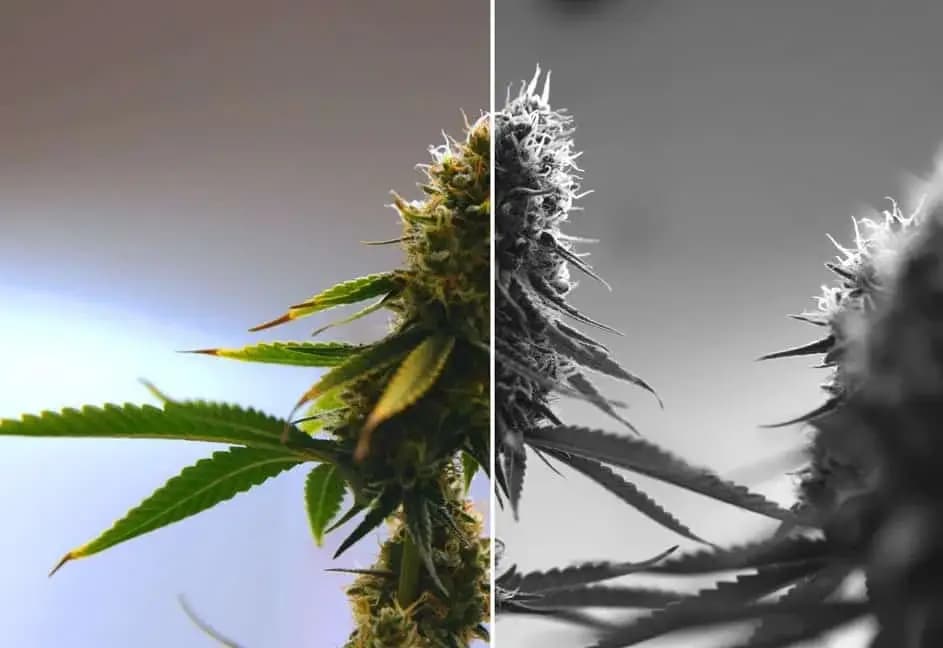
Many shoppers easily confuse THCA vs THC, assuming they are the exact same compound because they share a botanical origin. In reality, they offer entirely different user experiences based on whether they have been exposed to heat.
The core difference hinges on thermal activation. Raw THCA is completely non-intoxicating, whereas THC is the pre-activated compound responsible for immediate psychoactive effects. Smoking or vaping raw flower converts THCA into active THC, unlocking an identical cannabis experience.
This guide breaks down the critical THCA vs THC differences, exposing which gets you high, which flower is stronger, and how their effects compare. Read on to discover potential side effects and the shifting legal rules you must know before buying today. And if you already know the science and just want clean, lab-tested flower, explore our USDA Certified Organic THCA flower.
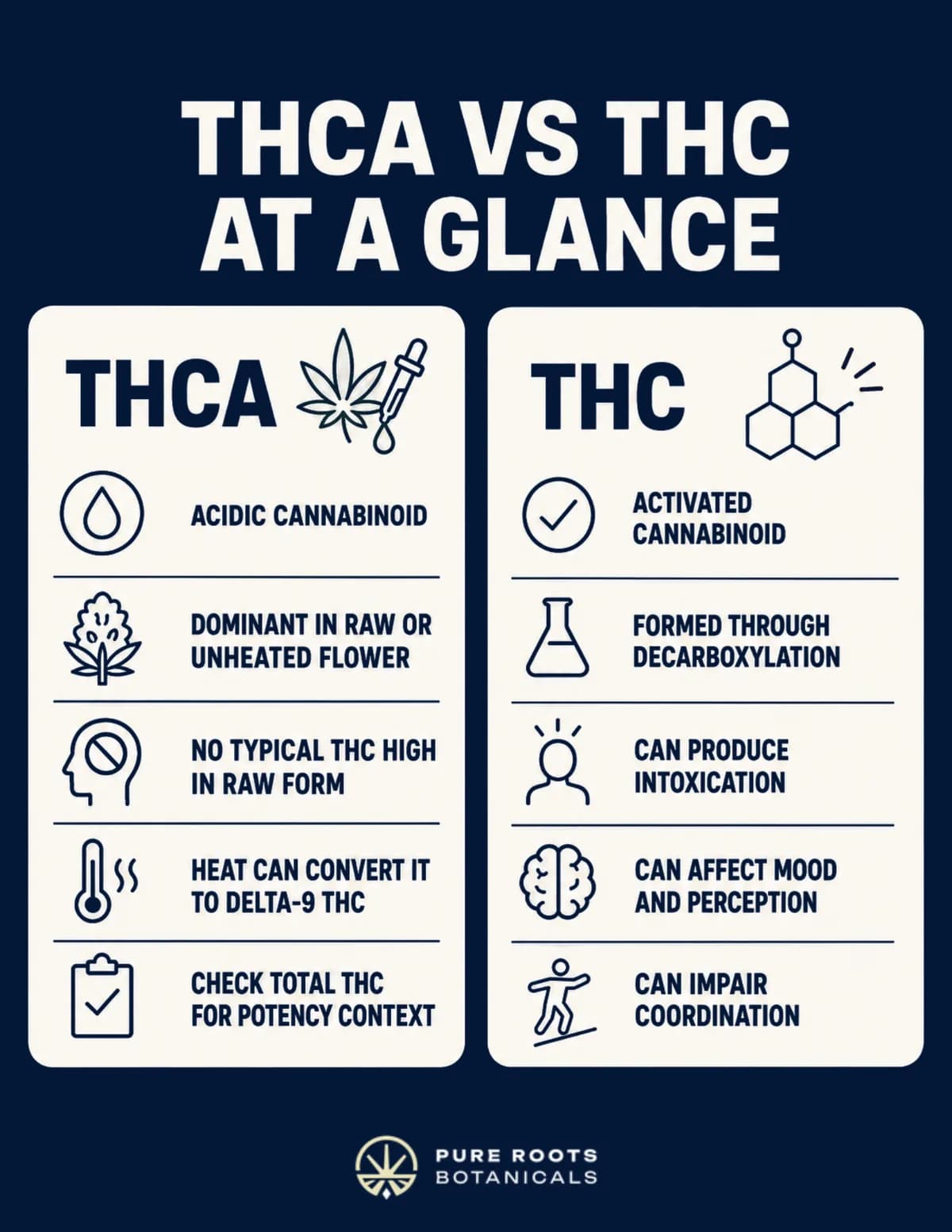
THCA vs THC at a Glance
| Feature | THCA | THC |
|---|---|---|
| Full Name | Tetrahydrocannabinolic acid | Tetrahydrocannabinol |
| Form | Raw acidic cannabinoid | Activated cannabinoid |
| Found In | Raw cannabis/hemp flower | Heated, decarboxylated cannabis products |
| Gets You High? | Not in raw form | Yes |
| Needs Heat? | Yes, to convert into THC | No |
| Common Products | THCA flower, pre-rolls, diamonds, raw tinctures | Flower, vapes, edibles, oils, concentrates |
| Main Buyer Concern | What happens when heated? | Potency and effects |
| Drug Test Risk | Yes, especially if heated | Yes |
What Is THCA?
THCA, short for tetrahydrocannabinolic acid, is a cannabinoid the cannabis plant produces naturally as it grows. It isn’t something added or synthesized later; it’s the plant’s original form of the compound most people are chasing when they buy cannabis.
Understanding how this compound behaves in its initial state requires looking at a few core chemical facts:
- The raw precursor – THCA is the unheated predecessor that turns into THC; every potent strain starts as THCA flower.
- Natural abundance – Fresh cannabis plants naturally produce high levels of THCA and only trace amounts of active Delta-9 THC.
- Molecular structure – THCA carries an extra carboxyl group that THC lacks, entirely altering how it interacts with the body.
- Receptor binding – This extra molecular group physically blocks raw THCA from binding to the brain’s CB1 receptors, preventing intoxication.
That’s the whole reason raw THCA doesn’t produce the classic cannabis high. It’s not that the plant is “weaker”. It’s because the molecule hasn’t been chemically converted yet.
What Is THC?
The term “THC” typically refers to Delta-9 THC, the primary compound responsible for the intoxicating, euphoric, and mind-altering effects of cannabis. Unlike its raw predecessor, THC is fully active out of the packaging and binds efficiently to the brain’s CB1 receptors. This immediate interaction alters several cognitive and physical functions, including:
- Mood and perception – Creating feelings of euphoria, relaxation, or sensory shifts
- Appetite – Stimulating hunger, commonly referred to as “the munchies”
- Motor control – Temporarily slowing down coordination, memory recall, and reaction times
While the overall intensity of these effects varies by dose, delivery method, and personal tolerance, the underlying mechanism remains consistent. THC is pre-activated and ready to interact with the body, whereas THCA remains entirely dormant until heated.
What’s the Difference Between THC and THCA?
Understanding the difference between these two compounds requires clearing up a few common misunderstandings about how they work and how they are labeled. Their relationship boils down to raw potential versus immediate effects.
A THCA label doesn’t mean a product is weak or mild. If you buy a product meant to be smoked, vaped, or dabbed, the label only describes the plant before you light it. The moment you introduce a flame, the heat instantly transforms the raw THCA into active THC. This is why lab tests calculate the total strength based on what the product becomes after heating.
Keep these basic facts in mind:
- 100% natural – THCA grows naturally in the plant and is not a fake, man-made chemical.
- The starting line – THCA is simply the raw version of THC before it changes.
- Real cannabis – It is the natural source that turns into the exact same THC found in traditional dispensary products.
How THCA Turns Into THC
The conversion process is called decarboxylation, often shortened to “decarb” in cannabis circles. Heat removes the acid group (that extra COOH structure) from THCA, leaving behind Delta-9 THC.
Decarboxylation happens through:
- Smoking
- Vaping
- Dabbing
- Baking
- Cooking
This chemical conversion can also happen slowly and passively over time through prolonged exposure to heat, light, and oxygen. This environmental degradation triggers accidental decarboxylation, which is why older, improperly stored flower often shows a much higher ratio of active THC than freshly harvested flower.
To simplify the entire timeline, the process always moves in a straight line from raw plant to activated compound. It begins as raw flower where only THCA is present. Once a consumer applies heat, decarboxylation occurs instantly. This heat exposure triggers the final phase, creating activated cannabis where active THC is now present and ready to take effect.
Does THCA Get You High?
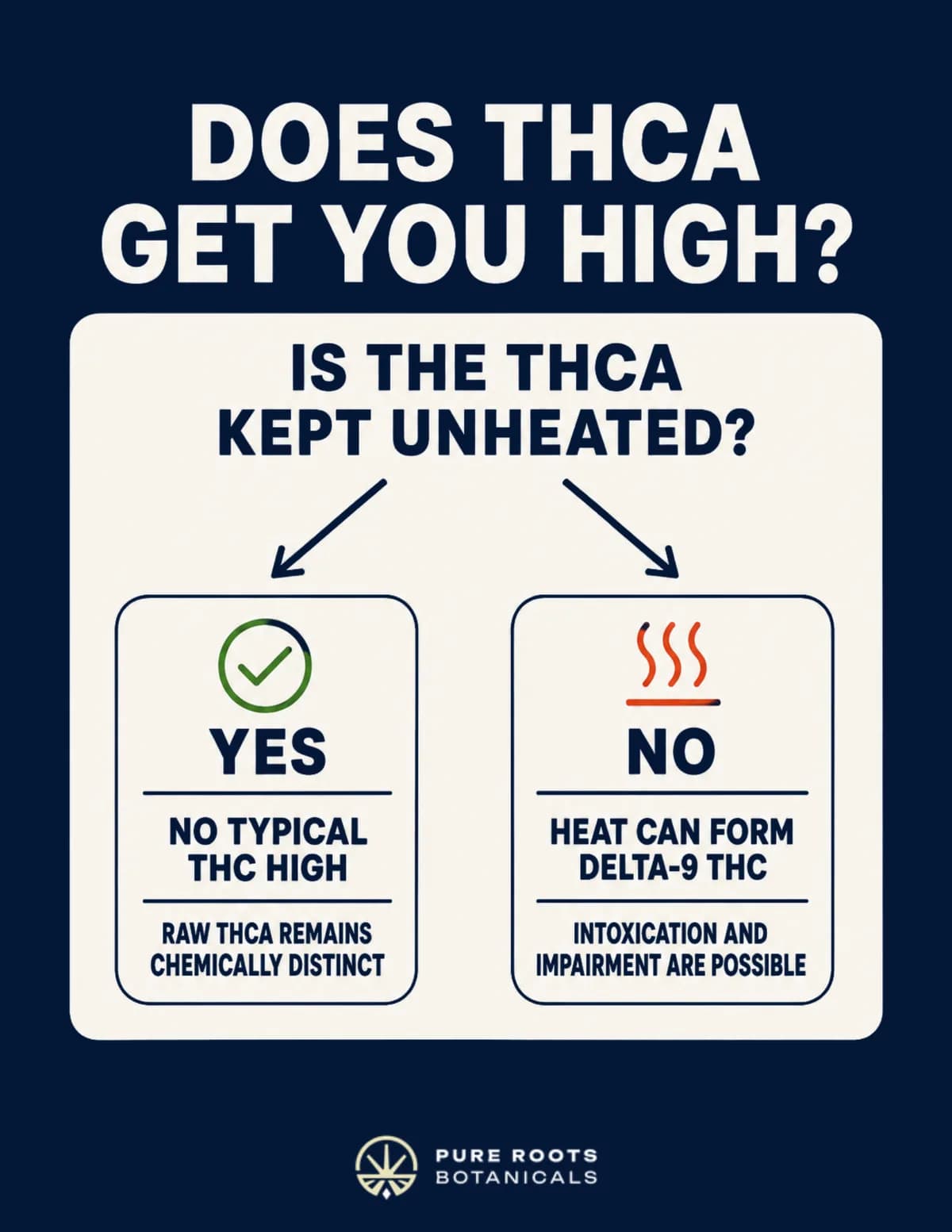
Raw THCA doesn’t get you high, but heated THCA absolutely will. This distinction is crucial because the effects change completely depending on how you consume the product. Eating raw THCA flower, swallowing a raw capsule, or juicing fresh leaves will not cause any intoxication because the unheated molecule cannot bind efficiently to the brain’s CB1 receptors.
However, the claim that THCA is non-intoxicating becomes highly misleading when applied to vapes, concentrates, or flower. The moment you introduce heat through a flame, vape battery, or oven, the THCA instantly converts into standard Delta-9 THC. Because you are actually inhaling activated THC, smoking or vaping a THCA product will deliver the exact same classic cannabis high as traditional dispensary options.
THCA Flower vs THC Flower
The debate between THCA flower and traditional THC flower is one of the most common points of confusion for consumers. In reality, this comparison is less about two different plants or distinct drugs and more about two different legal pathways and marketing strategies leading to a comparable end product. Most cannabis flower, regardless of how it is ultimately labeled or sold, naturally produces THCA as its dominant cannabinoid while growing.
Understanding the labeling divide
The split between these two types of flower comes down to where they are sold and how their chemical profiles are framed for regulatory compliance.
Traditional THC flower is sold exclusively through state-licensed dispensaries, with labeling that emphasizes the final intoxicating potential by combining THCA and active THC under a “Total THC” banner. Conversely, THCA flower is grown under federal hemp regulations and sold in standard retail or online channels, legalizing it because the raw, unheated form remains below the 0.3% Delta-9 THC limit.
Why the real-world experience is identical
Because THCA turns into standard Delta-9 THC the exact second you introduce heat, the real-world effects, onset speed, and overall high of both flowers are remarkably similar. If you smoke or vape them, your body receives the same active compound. Therefore, any variations you experience between two flower products rarely come down to the THCA vs THC designation. Instead, the differences depend on:
- Cultivation and environment – Whether the plant was grown indoors, outdoors, or in a greenhouse
- Terpene profiles – The aromatic compounds that dictate the specific aroma, flavor, and nuance of the high (such as relaxation versus focus)
- Cure and freshness – How well the flower was dried, cured, and stored, which affects smoothness and moisture content
- Testing standards – The rigorousness of the state-mandated or voluntary third-party lab testing used to verify safety and chemical purity
Is THCA Flower the Same as THC Flower?
Not exactly on paper, but once it’s smoked or vaped, high-THCA flower can produce a THC-like experience.
Before heat is applied, THCA and THC are chemically distinct compounds with different receptor behavior. After heat is applied, THCA converts into THC, and the distinction that mattered on the label stops mattering in the body. This is precisely why so many shoppers end up comparing THCA flower directly against traditional cannabis flower, because functionally, once combusted, that’s an apples-to-apples comparison.
The one thing to avoid is assuming a THCA-labeled product is automatically non-intoxicating simply because of what’s printed on the jar, if that product is clearly intended to be smoked.
Is THCA Stronger Than THC?
Determining whether THCA is stronger than THC requires looking entirely at how the product is consumed, as their relationship changes completely the moment heat is introduced. In its raw, unheated form, THCA is completely non-intoxicating and inherently weaker than pre-activated THC.
However, comparing raw THCA percentages directly to Delta-9 THC percentages in isolation doesn’t give an accurate picture of real-world potency. The conversion that happens during smoking or vaping alters the math entirely:
- Raw THCA – Completely non-intoxicating on its own due to its locked molecular structure
- Active THC – Inherently intoxicating and fully ready to impact the body out of the packaging
- Heated THCA – Converts directly into standard Delta-9 THC during the inhalation process
Because of this chemical shift, the only metric that truly dictates final potency is the “Total THC” calculation found on product lab reports. This percentage uses a specific formula to account for the exact amount of THC created after heat triggers decarboxylation. Ultimately, once a high-THCA product is smoked or vaped, it delivers the exact same hard-hitting strength and psychoactive experience as traditional THC.
THCA to THC Conversion – The 0.877 Rule
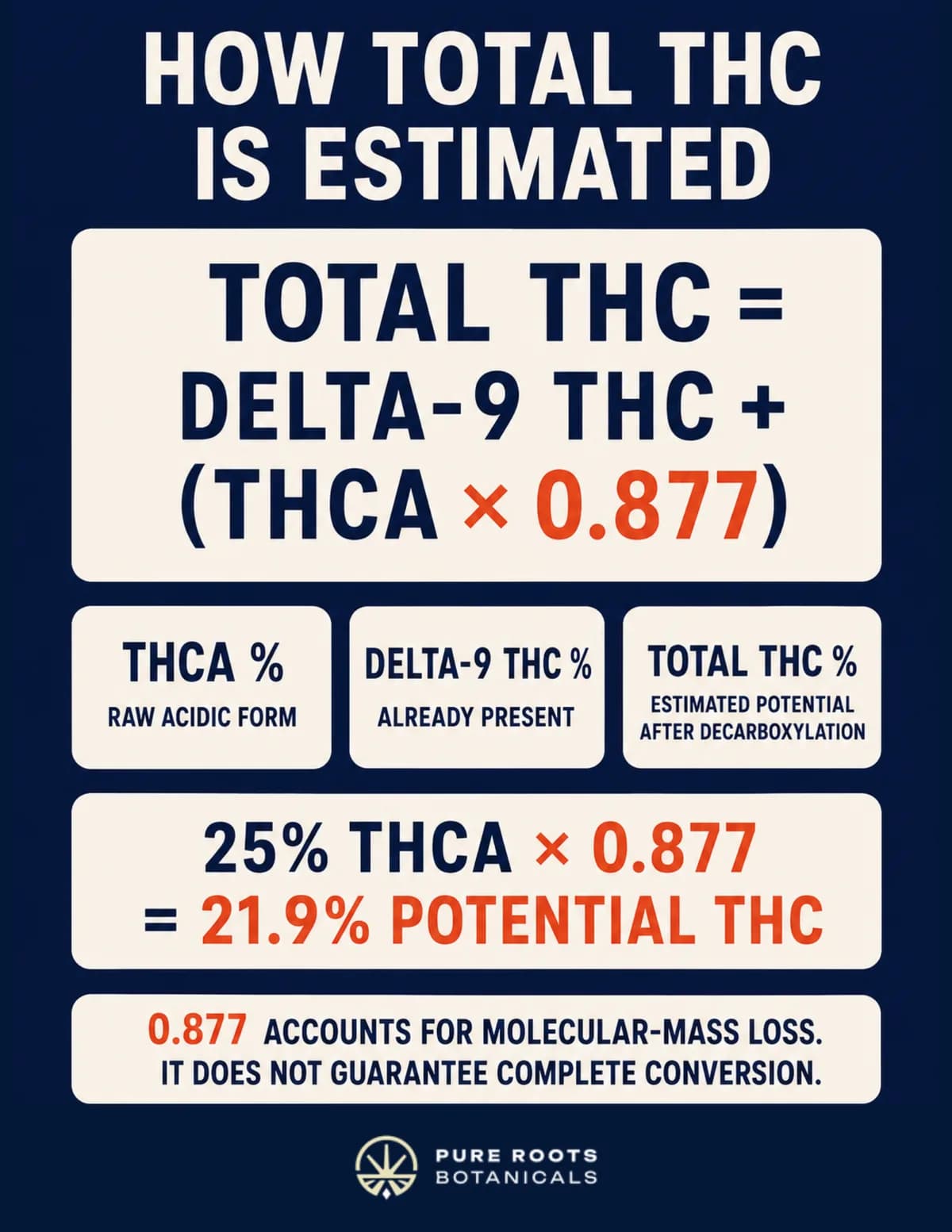
THCA doesn’t convert into THC at a clean 1:1 ratio. Some mass is lost during decarboxylation as the molecule sheds its carboxyl group, which is where the widely used 0.877 conversion factor comes from.
The standard estimate:
- THCA % × 0.877 = potential THC from THCA
The full total THC formula used on most lab reports:
- Total THC = Delta-9 THC + (THCA × 0.877)
Here’s how that plays out in practice:
| Labeled THCA % | Estimated Converted THC |
|---|---|
| 18% THCA | ~15.8% THC |
| 22% THCA | ~19.3% THC |
| 25% THCA | ~21.9% THC |
| 28% THCA | ~24.5% THC |
| 30% THCA | ~26.3% THC |
Or skip the mental math entirely: drag the slider to any labeled THCA percentage and see the potential THC it converts to.
Try it yourself
THCA to THC Calculator
25% THCA × 0.877 = ≈ 21.9% potential THC · ~3.1% lost as CO₂
The 0.877 factor is a chemical ceiling that accounts for molecular-mass loss during decarboxylation. It does not guarantee complete conversion, so real-world results can be lower.
Understanding THCA % vs THC % vs Total THC %
When looking at a product label or a third-party lab report, you will usually see three distinct numbers that explain the exact potency of what you are buying:
- THCA % – The raw, unheated cannabinoid percentage present in the plant before any flame is introduced.
- Delta-9 THC % – The amount of already-active, intoxicating THC present in the product exactly as it sits on the shelf.
- Total THC % – The final estimated potency available after you apply heat, which combines both figures using a specific conversion formula.
A raw flower can technically display a very low Delta-9 THC percentage while carrying a massive THCA percentage. Even though the active THC number looks incredibly small on the packaging, that exact same flower will still deliver a powerful, heavy-hitting high the moment it is smoked. For flower, pre-rolls, and concentrates, the Total THC figure is always the most accurate metric to check. This discrepancy is precisely why verifying third-party lab reports matters far more than just looking at the flashy numbers printed on the front of a bag.
How to Read a THCA Flower COA
A Certificate of Analysis (COA) is the official third-party lab report that verifies exactly what is inside your product, serving as a much more reliable safety metric than the flashy percentages printed on the packaging. When reviewing a COA for THCA flower, you should always check for the following data points to ensure quality, accuracy, and compliance:
- Batch verification – Confirm that the batch number and testing date on the lab report match the product labeling exactly.
- Cannabinoid profile – Check the specific percentages for THCA, Delta-9 THC, and Total THC to understand the true legal compliance and heated potency.
- Aroma analysis – Review the terpene profile to determine the strain’s specific flavor, scent, and potential nuance of effects.
- Contaminant screenings – Verify that the product has passed rigorous testing for pesticides, heavy metals, mold, microbials, and residual solvents.
A lab report that is missing several of these essential categories, is outdated, or features a batch number that doesn’t match your packaging is a major red flag. If a brand cannot provide a clean, verifiable COA for its current inventory, it is a clear signal to look elsewhere for your products.
Effects – THCA vs THC
| Category | Raw THCA | Heated THCA / THC |
|---|---|---|
| Intoxication | No typical high | Can produce a high |
| Onset | Depends on the product | Fast when smoked/vaped |
| Best-known Use Context | Raw/unheated cannabis products | Flower, vapes, edibles, concentrates |
| Mental Effects | Generally clear-headed | Can alter mood, perception, and coordination |
| Impairment Risk | Lower in raw form | Yes |
Individual experiences with these compounds vary significantly based on dosage, consumption methods, and personal tolerance. Because cannabinoids interact uniquely with each person’s body chemistry, these descriptions should not be viewed as guaranteed outcomes or direct medical claims.
Is THCA Legal?
The legal status of THCA is highly complex and constantly evolving due to overlapping federal rules and individual state regulations. Understanding where it stands requires looking at how hemp laws are written and how they are shifting.
The current federal framework
Under the 2018 Farm Bill, hemp-derived products are federally legal as long as they contain less than 0.3% Delta-9 THC by dry weight. Because THCA is chemically distinct from Delta-9 THC prior to heating, high-THCA flower and concentrates technically meet this criterion, allowing them to be sold nationwide.
The shifting landscape
The legal landscape is tightening dramatically across the country:
- The “Total THC” standard – A growing number of state regulators have moved away from the Delta-9 threshold, choosing instead to enforce a “Total THC” calculation. This math combines THCA and Delta-9 THC together, which effectively outlaws high-potency THCA flower.
- State bans and restrictions – Regardless of federal hemp permissions, various states have passed independent laws that restrict or completely ban THCA flower, vapes, and inhalables.
Because regulations can change rapidly, consumers must always verify local and state statutes before purchasing. To maintain full compliance with these shifting regional restrictions, brands like Pure Roots Botanicals don’t ship THCA products to locations where they are prohibited.
Will THCA Show Up on a Drug Test?
Yes, THCA can absolutely cause you to fail a standard drug test.
Standard drug tests are generally designed to detect THC metabolites, and most don’t distinguish based on which cannabinoid originally produced that metabolite. Since smoked or vaped THCA converts into Delta-9 THC, that converted THC can absolutely register as a positive result. If drug testing is a concern for any reason, it’s safest to avoid THCA and THC products altogether, regardless of how a product is labeled.
Side Effects and Safety Considerations
For heated THCA or THC products, potential effects and side effects can include:
- Dry mouth
- Red or bloodshot eyes
- Anxiety or paranoia in some users
- Impaired coordination
- Slower reaction time
- Memory or focus changes
- Increased heart rate
- Stronger effects with high-potency flower
A few safety practices worth following:
- Start low, especially with a product you haven’t tried before
- Don’t drive or operate machinery after use
- Keep all products away from children and pets
- Avoid mixing with alcohol
- Talk to a healthcare professional first if you’re pregnant, nursing, taking medication, or managing a medical condition
Common Misconceptions About THCA vs THC
“THCA means it won’t get you high.”
Only true if the THCA stays unheated. Smoking or vaping it changes the equation entirely.
“THCA flower is fake weed.”
No. THCA occurs naturally in cannabis flower; it’s not a synthetic substitute.
“Delta-9 THC % tells the whole story.”
Not for flower. Once heat is part of the equation, total THC is the number that actually reflects potential strength.
“THCA is always legal.”
No. Legality varies by state and can depend on total THC calculations, not just raw THCA content.
“THCA is always weaker than THC.”
Raw THCA is non-intoxicating, but high-THCA flower can produce potent effects once it’s heated.
Is THCA Better Than THC?
Neither compound is objectively superior; the right choice depends entirely on your consumption preferences and legal access.
Who is THCA best for?
- Hemp shoppers – Consumers who want easy access to hemp-derived products online or in local retail shops.
- Raw wellness users – Individuals seeking raw, non-intoxicating formats like fresh juices or unheated tinctures.
- Traditional smokers – Users who enjoy the ritual of grinding raw flower to trigger a classic high.
Who is THC best for?
- Dispensary loyalists – Shoppers who prefer buying from state-licensed, strictly regulated cannabis programs.
- Convenience seekers – People who want ready-to-use, pre-activated edibles and oils that require zero heat.
- Precise microdosers – Consumers who rely on clear, pre-calculated milligram dosing to control their high.
Ultimately, THCA is ideal for versatile hemp access and flower rituals. Conversely, standard THC is best for pre-activated convenience and strict state oversight.
Where to Buy Premium THCA Flower
Not all THCA flower is created equal, and quality starts well before the product ever reaches a jar. Cultivation practices, harvest timing, drying, curing, and testing all shape the final product, and shortcuts at any of those stages show up in the smoking or vaping experience.
Pure Roots Botanicals grows organic hemp flower with transparent, batch-matched lab testing, so what’s on the COA is what’s actually in the jar. If you’re ready to see the difference quality cultivation makes, explore our current THCA flower selection.
Final Takeaway
While THCA vs THC are closely related, they are distinct compounds rather than interchangeable terms. THCA remains the raw, non-intoxicating form found in unheated cannabis, whereas THC is the pre-activated, intoxicating form created once heat is introduced. Decarboxylation serves as the chemical bridge between the two, transforming a dormant cannabinoid into a psychoactive experience.
For any product meant to be smoked or vaped, the Total THC figure on a lab report is the most accurate indicator of real-world potency. High-THCA flower delivers an experience virtually identical to traditional THC flower once lit. For this reason, checking verified lab reports, tracking fast-shifting legal regulations, and verifying product purity matter far more than the headline number printed on the packaging.
Grasping this single distinction between raw and activated states makes every other question regarding cannabis labeling, safety, and legality much easier to navigate.
Found this useful? Share it.
Written by
Ben Cerullo
Founder & Master Grower · Pure Roots Botanicals
Ben Cerullo founded Pure Roots Botanicals after years in organic agriculture, driven by a belief that hemp consumers deserve federal-grade transparency. He manages USDA Certified Organic operations at the North Carolina farm (NOP ID: 5561006795) and writes on hemp education, organic certification, and consumer safety.