

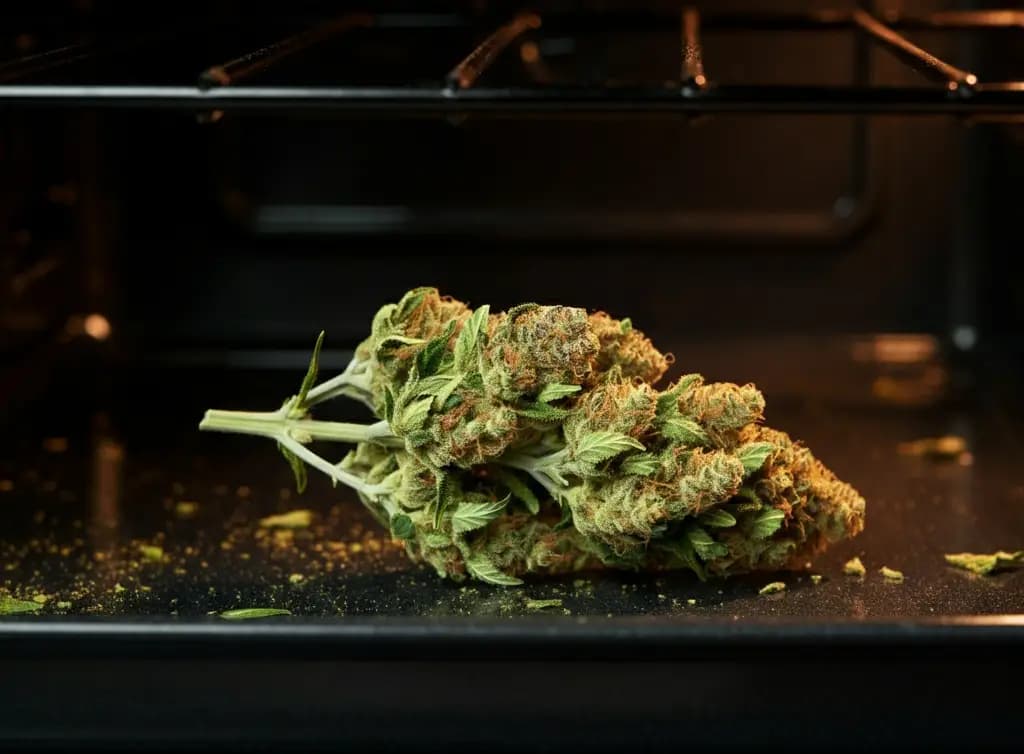
Decarboxylation, or decarbing, is how raw THCA becomes the active THC you can actually feel in edibles. Heat removes a carboxyl group (-COOH) from the THCA molecule and switches it on. It sounds simple, and the chemistry is well understood, but the difference between a potent, flavorful batch and a scorched, weak one comes down to two dials: time and temperature. Here is how to get it right at home, backed by the lab data on what actually happens inside your flower.
Key Factors in Decarbing (Time, Temperature, and Terpenes)
Decarbing comes down to balancing heat, time, and terpene preservation. In a controlled 2016 study, THCA converted almost completely to THC in about 30 minutes at 110°C (230°F), and far faster at higher temperatures, taking just 6 minutes at 145°C (Wang et al., Cannabis and Cannabinoid Research, 2016). Go too low and you under-activate; go too high and you start trading away flavor and risk degradation.
- Optimal temperature range: a reliable home target is 230 to 250°F (110 to 121°C). At 240°F for about 40 minutes in an oven, most of the THCA converts, commonly 80 to 90%, while much of the aroma survives.
- Terpene preservation: terpenes start evaporating around 130 to 150°F (54 to 66°C), which is why your kitchen starts smelling like a dispensary. Lower-temperature, longer methods or a sealed container hold on to more of them.
- Avoid degradation: overcooking pushes THC toward CBN, a more sedating compound. Some people want that for sleep, but most do not. Notably, the 2016 study saw no significant CBN formation when heating in the dark without oxygen, so a sealed, controlled environment protects potency.
5 Common Home Decarb Methods
There is no single best method, only the best one for your priorities: potency, flavor, or stealth. The four hands-on approaches below cover most home setups, and a fifth, slow-cooker infusion, appears in the comparison table further down. Each lands differently on the time-temperature curve.
Oven Decarboxylation (Baking Method)
The classic and simplest option. Preheat to 230 to 250°F (110 to 121°C), break buds into small pieces, spread them on parchment, and bake 30 to 40 minutes, stirring once halfway for even heat. You will know it is done when the color shifts from green to golden brown and the smell becomes unmistakable. Expect 80 to 90% conversion, in line with the lab figures, though some terpenes will escape into the air.
- Pros: easy, scalable, reliable results
- Cons: not discreet, your home will smell, and you lose some flavor
Mason Jar Decarb (Low-Odor Method)
Want less smell and more flavor? Loosely fill a clean canning jar with coarsely ground flower, twist the lid fingertip-tight, and place it in a cold oven. Heat to 240°F (115°C) and run it 40 to 60 minutes, shaking once halfway. The sealed jar traps aromatic terpenes, and the oxygen-limited environment helps protect THC from oxidizing, consistent with the 2016 findings. Let it cool before opening to avoid a hot, herb-scented steam burst.
- Pros: much lower smell, better terpene retention
- Cons: harder to monitor color, and hot glass needs careful handling
Decarb Devices (e.g., Ardent Nova)
For zero guesswork, dedicated decarb machines like the Ardent Nova are essentially the slow cooker of cannabis prep. Add flower, press a button, walk away. They hold roughly 230 to 250°F for 90 to 120 minutes in an insulated, sealed chamber, and some test at 95 to 100% conversion, the highest of any home method. Ideal for people who microdose or make edibles regularly and want consistency.
- Pros: foolproof, potent, low odor
- Cons: pricey, small capacity, and one more gadget on the counter
Sous Vide Decarb (Flavor Saver Method)
Best for flavor chasers. Set a sous vide circulator to 203°F (95°C), seal the flower in a vacuum or freezer bag, and submerge it in a water bath for about 90 minutes. Because everything stays sealed and precisely temperature-controlled, you keep most of the terpenes and almost no smell escapes. The result is potent and far more aromatic than a dry oven bake.
- Pros: best for flavor, nearly odorless, very consistent
- Cons: needs a sous vide setup, longer process, more prep
Comparing Decarb Methods: Efficiency, Ease, and Results
Each method trades one strength for another: some are easiest, some are smell-proof, and some protect flavor or maximize potency. If you want top conversion, a decarb device or a well-calibrated oven wins. If flavor is the priority, sous vide and the mason jar lead. Here is the full comparison, including the slow-cooker infusion option.
| Method | Efficiency (THCA to THC) | Terpene Retention | Odor Control | Ease of Use | Equipment Needed |
|---|---|---|---|---|---|
| Oven (open tray) | ~80 to 90% | Moderate loss | Strong smell | Very simple | Oven, tray, parchment |
| Oven (mason jar) | ~80 to 90% | Much better | Reduced smell | More careful | Oven, mason jar |
| Infusion (slow cook) | Varies, time-based | Depends on lid | Smells a bit | Convenient combo | Slow cooker, oil, strainer |
| Decarb device | ~95 to 100% | Sealed, some loss | Minimal odor | Push-button easy | Decarb machine |
| Sous vide | ~90 to 95% | Excellent | Almost none | Prep needed | Circulator, bag, pot |
Safety Precautions and Best Practices
Whatever method you choose, a few habits keep the process safe and your results consistent. None of this is complicated, but skipping it is how people scorch a batch or crack a jar.
Mind Your Temperature
Cannabis decarbs best between 230 and 250°F (110 to 121°C). Too low and the THCA never fully activates; too hot and you burn off potency or push THC toward sedating CBN. Push much higher and you flirt with combustion, since this is dried plant material. When in doubt, go a little lower and extend the time, which is exactly the trade-off the kinetics data supports.
Stay Close (Especially with Ovens and Stovetops)
Even at modest temperatures, do not wander off for hours. Ovens spike, glass can crack, and infusions can bubble over. Set a timer and check periodically, especially with any open-heat method.
Be Smart with Glass
Using a mason jar? Heat it gradually. Always start with the jar in a cold oven so they warm together, and never set a hot jar on a cold countertop, where thermal shock can shatter it. Use proper canning jars, not whatever container is handy.
Smell Happens
Even sealed devices and sous vide bags release aroma once you open them. If discretion matters, plan ahead: open containers when you have privacy, and run a fan or air purifier afterward. A tray decarb right before guests arrive is a mistake you only make once.
Label and Store Safely
Once decarbed, cannabis is active, meaning more potent and more readily absorbed. Label it clearly and store it well away from kids, pets, or anyone who might mistake it for a kitchen herb. Cooled decarbed flower is dry and crumbly, so handle it gently to avoid losing that valuable powder.
Conclusion: Using Your Decarbed THCA Flower
Decarbing is the step that makes THCA flower active. Unless you are smoking or vaping it raw, where heat does the job in real time, you need this step to unlock the full effect. The encouraging part is how forgiving it is once you respect the time-and-temperature window the science lays out.
Pick the method that matches your goal. For maximum THC yield, a calibrated oven or a decarb device gives the best conversion. For flavor and aroma, sealed methods like sous vide or the mason jar protect the most terpenes. For discretion, the sealed jar or a device keeps odor down. Once your flower is decarbed, the options open up:
- Infuse it into butter or oil
- Make tinctures or homemade edibles
- Fill capsules or sprinkle it into food
- Vape or even smoke it, though it may taste a touch roasted
Remember that edibles hit slower and last longer than inhaled cannabis, so start low and go slow. With a little practice, decarbing becomes second nature. Start with clean, well-grown flower and the results speak for themselves. Our USDA Certified Organic THCA flower is grown without synthetic pesticides and comes with a public Certificate of Analysis, which is exactly the clean input you want before you ever turn on the oven.
Rather skip the oven entirely? Our Delta-9 live rosin gummies are already activated, made with USDA Certified Organic live rosin and dosed at 10 mg each, so there is nothing to decarb.
Found this useful? Share it.
Written by
Ben Cerullo
Founder & Master Grower · Pure Roots Botanicals
Ben Cerullo founded Pure Roots Botanicals after years in organic agriculture, driven by a belief that hemp consumers deserve federal-grade transparency. He manages USDA Certified Organic operations at the North Carolina farm (NOP ID: 5561006795) and writes on hemp education, organic certification, and consumer safety.