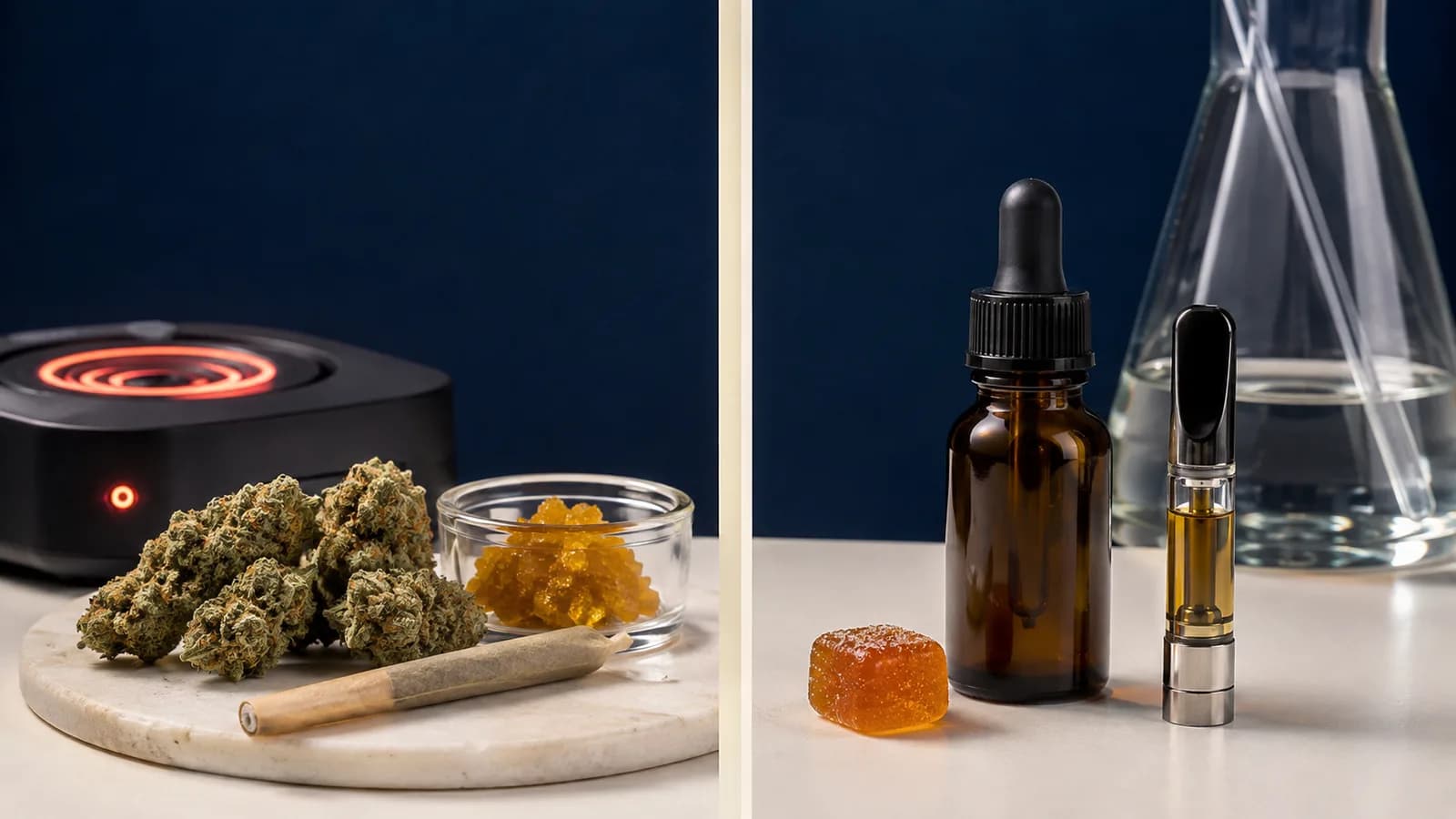
When exploring THCA vs Delta 8, consumers often find themselves navigating a complex landscape of distinct chemical structures, varying user experiences, and rapidly changing state regulations. While one relies on thermal activation to unlock its intense properties, the other offers a milder, chemically stable alternative right out of the packaging. Understanding these fundamental behavioral differences is essential for making safe, informed choices in a crowded marketplace.
Consumers interested in the raw cannabinoid can also explore available THCA flower products before comparing their effects and characteristics.
This guide analyzes how THCA and Delta 8 affects your body, verifies crucial lab test results, and examines local legal considerations to help you choose the better option today.
THCA vs Delta 8
When comparing THCA vs Delta 8, the main difference is immediate, mild psychoactivity versus delayed, heavy-hitting potency. Raw THCA is completely non-intoxicating and sits dormant until thermal activation, like smoking or vaping, converts it into mind-altering Delta-9 THC. In contrast, Delta 8 requires zero heat and is psychoactive straight out of the packaging.
This heat requirement directly dictates their final strength. Once heated, THCA transforms into a traditional, high-potency cannabis high that is significantly stronger than Delta 8. Meanwhile, Delta 8 delivers a much milder, clear-headed buzz. THCA is a raw powerhouse requiring a flame to unlock, while Delta 8 is a ready-to-use, gentler alternative.
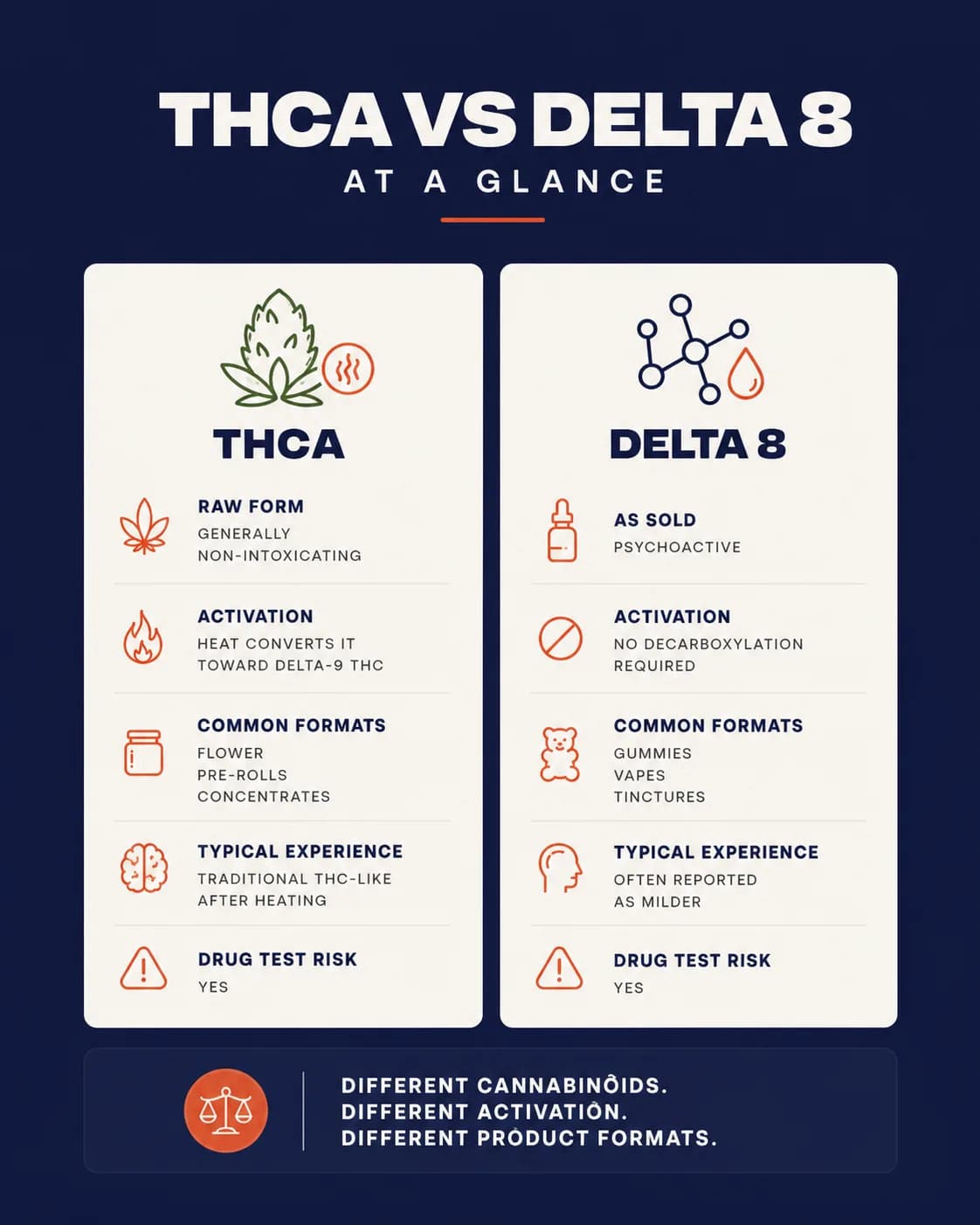
THCA vs Delta 8 at a Glance
| Category | THCA | Delta 8 |
|---|---|---|
| Raw Effect | Non-intoxicating | Psychoactive |
| Needs Heat? | Yes, for THC-like effects | No |
| Typical Strength | Stronger once smoked/vaped | Usually milder |
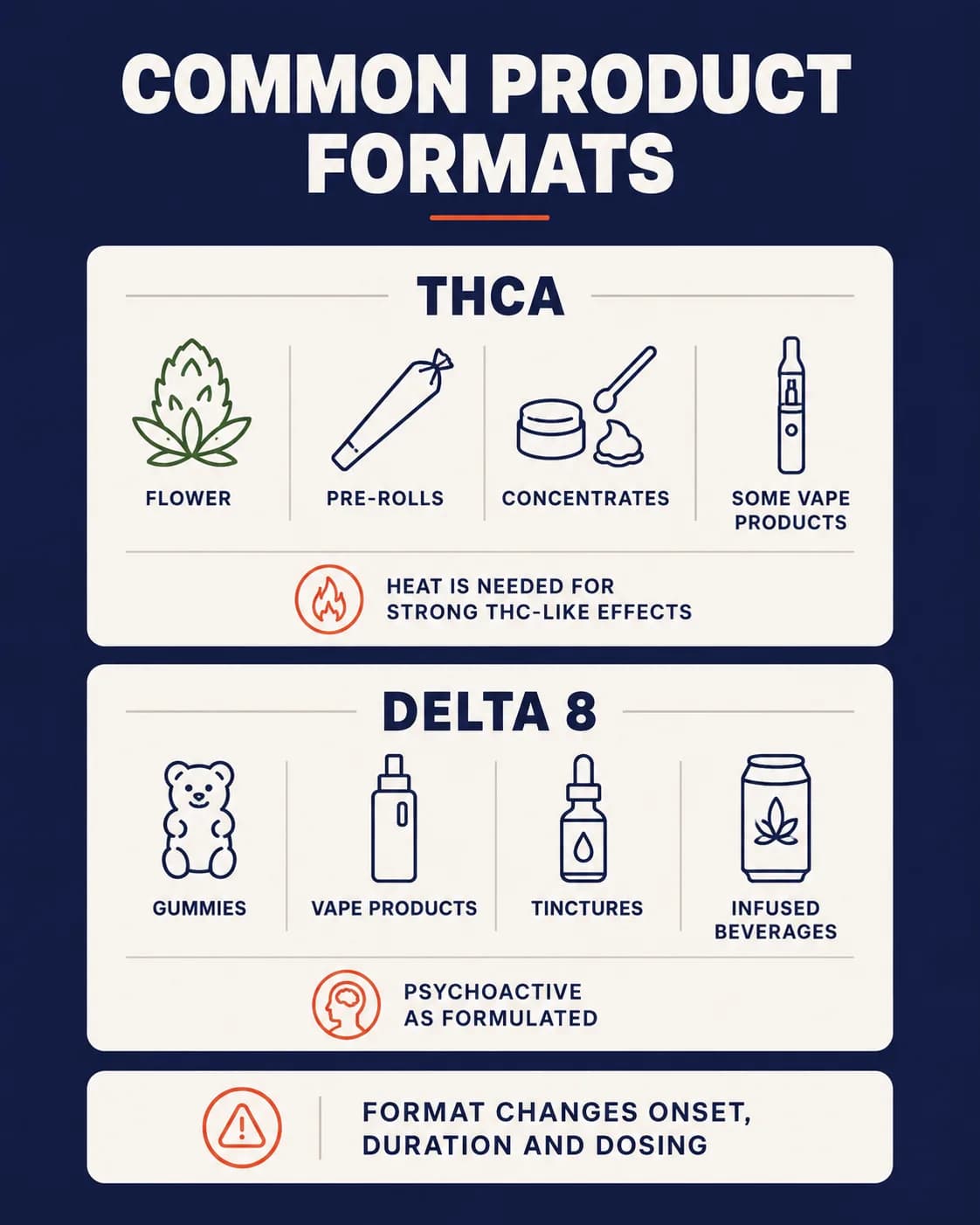
| Common Products | Flower, pre-rolls, concentrates | Gummies, vapes, tinctures |
| Feels Like | Traditional cannabis, once heated | A lighter THC-style effect |
| Drug Test Risk | Yes | Yes |
| Best For | A flower-style experience | A milder, hemp-derived experience |
What Is THCA?
THCA stands for tetrahydrocannabinolic acid. It’s one of the most abundant cannabinoids in raw, unheated cannabis and hemp flower, often making up a larger percentage of the plant’s cannabinoid content than THC itself.
Structurally, THCA is nearly identical to THC, but it carries an extra carboxyl group. That single molecular difference is the whole story. The carboxyl group physically blocks THCA from binding efficiently to CB1 receptors in the brain, which is why raw THCA doesn’t get you high, no matter how much of it you consume in a smoothie or salad.
Apply heat, though, and that carboxyl group breaks off. What’s left is Delta-9 THC, chemically indistinguishable from THC produced any other way. This is why THCA flower is often marketed to people who want the “real” cannabis flower experience, because once you light it, that’s exactly what you’re smoking.
What Is Delta 8?
Delta 8 THC is a psychoactive cannabinoid that’s structurally close to Delta-9 THC, with one key difference – the location of a double bond in its molecular chain. Delta-9 THC has that bond on the ninth carbon atom, while Delta-8 has it on the eighth. That small shift changes how efficiently the molecule binds to CB1 receptors, which is the underlying reason Delta 8 is typically felt as calmer and less intense than Delta-9.
Delta 8 does occur naturally in cannabis and hemp plants, but only in trace amounts, nowhere near enough to supply commercial demand. Nearly all Delta 8 sold today is produced through isomerization, a lab process that converts hemp-derived CBD into Delta 8 THC using acids or catalysts.
Because it’s already active, Delta 8 shows up in fast-acting, easy-to-dose formats like gummies, vape cartridges, tinctures, and infused beverages. No heating step, no flower, no combustion required.
Is THCA the Same as Delta 8?
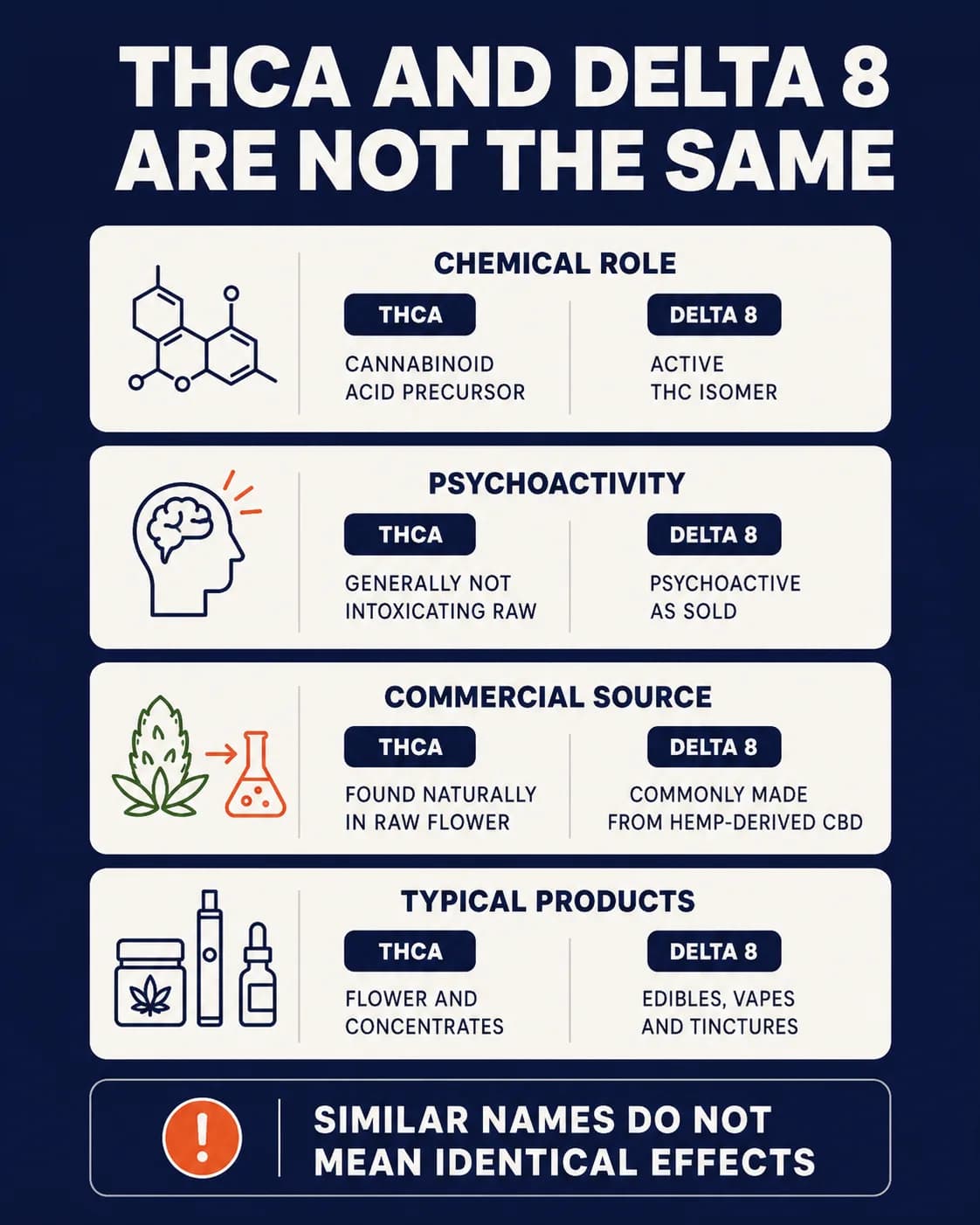
No. They’re different cannabinoids with distinct chemical structures, activation requirements, and typical use cases.
- Different chemical forms – THCA carries a carboxyl group; Delta 8 is a full isomer of Delta-9 THC.
- Different activation process – THCA needs heat to become psychoactive; Delta 8 is psychoactive as sold.
- Different product formats – THCA dominates flower and concentrates; Delta 8 dominates edibles and vapes.
- Different user expectations – THCA buyers are usually chasing a traditional smoking/vaping experience; Delta 8 buyers are usually chasing a controlled, milder edible or vape experience.
What Is the Difference Between THCA and Delta 8?
At the core, the difference comes down to this – THCA is a precursor. Delta 8 is an active THC isomer.
THCA is what you find in raw, unprocessed flower; it’s the cannabinoid nature actually produced in the highest volume in most hemp cultivars. Delta 8, by contrast, is almost always the product of a manufacturing process that starts with CBD.
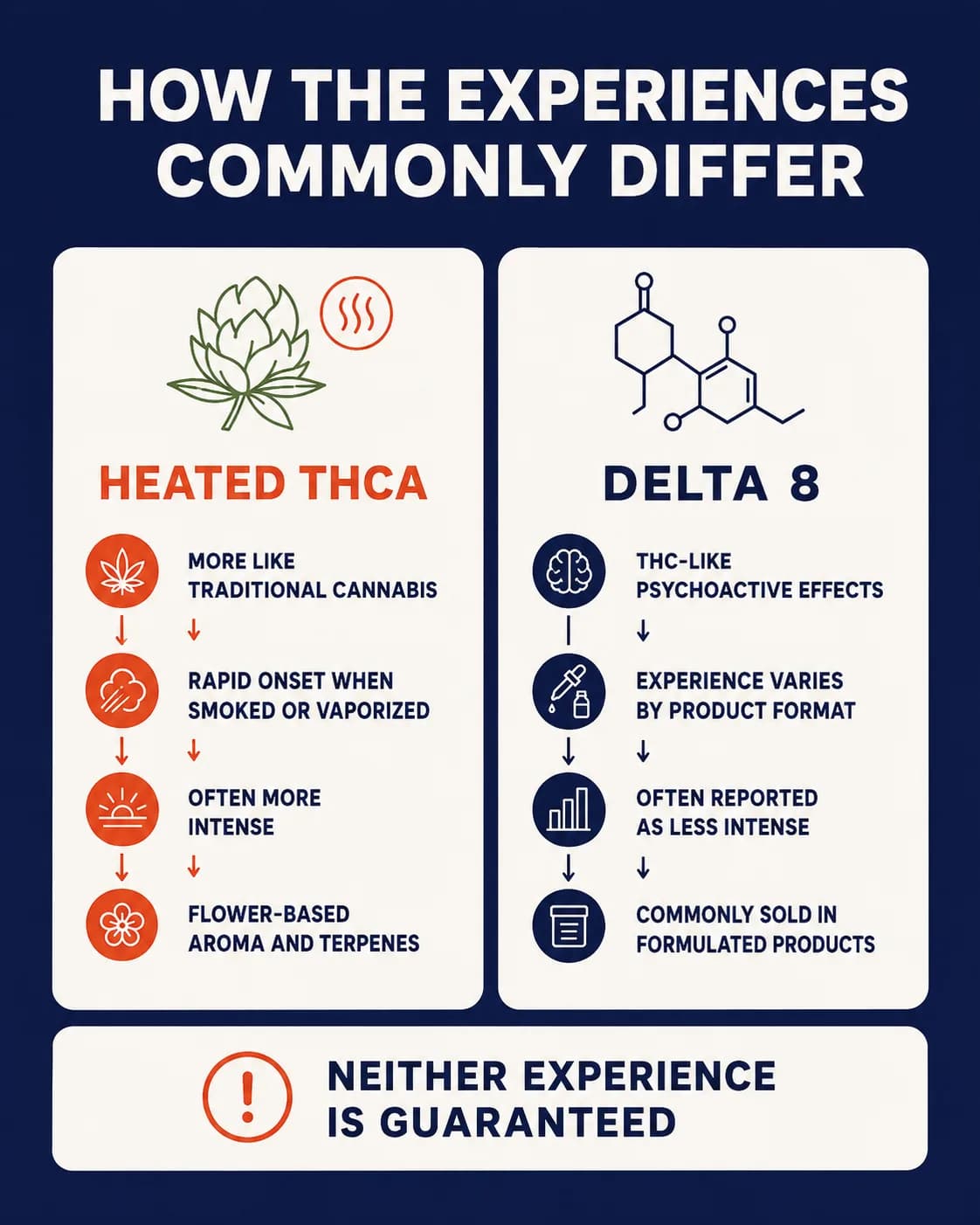
Because THCA only becomes psychoactive after decarboxylation, smoking or vaping THCA flower delivers an experience very close to conventional cannabis. It provides the exact same terpene profile, strain-specific aroma, and rapid onset speed you would expect from traditional flower. Delta 8 skips that step entirely and is chosen specifically by people who want something gentler than what flower typically delivers.
Is THCA Stronger Than Delta 8?
Determining which compound is stronger depends entirely on whether heat is applied, as consumption methods dictate actual potency.
- Raw THCA – Completely non-intoxicating and weaker than Delta 8
- Heated THCA – Converts to Delta-9 THC, making it significantly stronger than Delta 8
- Delta 8 – Inherently psychoactive but delivers a much milder, gentler buzz
Ultimate strength also depends heavily on dosage, product quality, and individual tolerance. A heavily packed bowl of THCA flower will easily hit harder than a standard Delta 8 gummy. Conversely, a high-dose Delta 8 edible can easily overpower a single, small puff of THCA flower.
Is THCA Better Than Delta 8?
Neither cannabinoid is objectively superior; they simply cater to different user preferences and wellness goals.
Who is THCA best for?
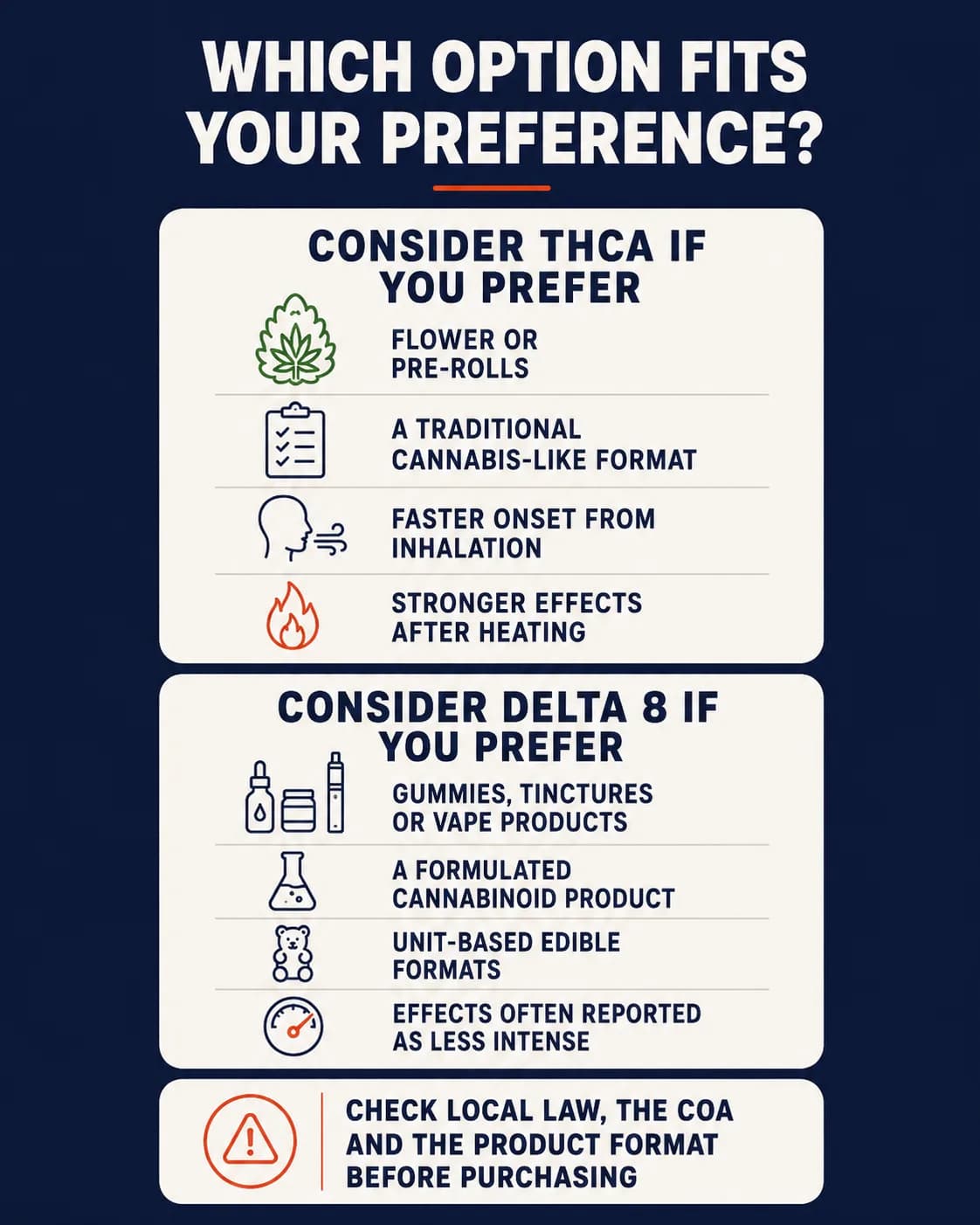
- Traditionalists – Users who prefer raw flower or pre-roll formats
- Potency seekers – Consumers wanting strong, authentic cannabis effects once heated
- Aroma enthusiasts – Individuals chasing distinct, strain-specific terpene profiles
Who is Delta 8 best for?
- Microdosers – People seeking a mild, predictable, clear-headed high
- Convenience lovers – Users preferring pre-activated gummies, vapes, or tinctures
- Anxiety-prone users – Individuals wanting an experience unlikely to become overwhelming
So, Delta 8 serves as the gentler starting point for beginners or those sensitive to THC. Conversely, THCA provides the most direct route if you are chasing a traditional dispensary-style experience.
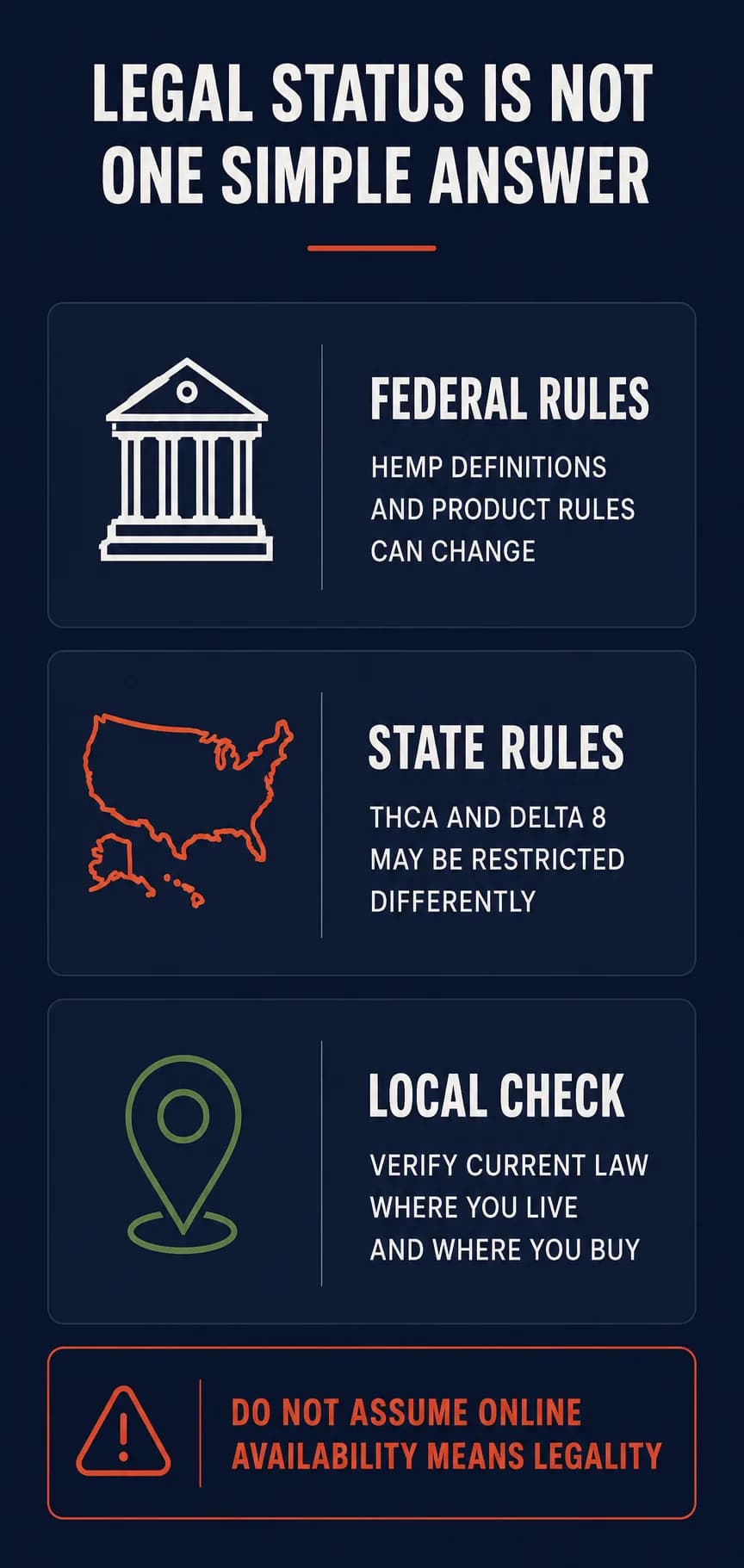
Legal Considerations – And a Change Coming in December 2026
Hemp-derived cannabinoids are regulated at both the federal and state levels. Historically, inconsistent enforcement is exactly what allowed THCA and Delta 8 to flourish as widely available marketplace products.
The 2018 Farm Bill loophole
Since the 2018 Farm Bill, hemp products have generally been legal federally as long as they measured under 0.3% Delta-9 THC by dry weight. Because that threshold was written specifically around Delta-9, it left room for THCA-rich flower (which is non-intoxicating until heated) and lab-converted Delta 8 to be sold nationwide, even in states without legal recreational cannabis.
The upcoming December 2026 shift
That loophole is closing due to Section 781 of the Continuing Appropriations and Extensions Act, 2026. Taking effect on December 11, 2026, the updated federal legislation redefines hemp to count total THC, explicitly including THCA and Delta 8, rather than Delta-9 alone. Furthermore, it caps finished hemp products at just 0.4 milligrams of total THC per container. Once active, industry estimates suggest up to 95% of current hemp-derived products will fail to meet the federal definition of legal hemp.
What consumers and businesses should know
- Pending challenges – Several standalone bills and regulatory framework efforts are underway to delay or restructure the ban, so the final outcome is not yet set in stone.
- State laws take priority – State regulations vary independently of federal rules; states like Texas are already moving to ban or heavily restrict these isomers ahead of the federal timeline.
- Verify before buying – Buyers should check current local statutes before purchasing and never assume “federally legal” today guarantees legality in the coming months.
Why Lab Testing Matters for Both
Regardless of which cannabinoid you choose, a Certificate of Analysis (COA) from third-party lab testing is the single best way to know what’s actually in the product.
Good lab testing confirms:
- Actual cannabinoid levels (not just what’s on the label)
- Delta-9 THC content, which matters for both legal compliance and expected potency
- Overall potency, so dosing isn’t a guessing game
- Screening for contaminants like pesticides, heavy metals, and residual solvents
Lab testing is especially important for Delta 8, since it’s produced through a chemical conversion process rather than occurring naturally in the plant. Poorly controlled isomerization can leave behind unwanted byproducts that don’t show up unless a lab specifically tests for them. A COA turns a marketing claim into a verifiable fact.
Which One Should You Choose?
| Choose THCA if you want... | Choose Delta 8 if you want... |
|---|---|
| Flower or pre-rolls | Gummies, vapes, or tinctures |
| Stronger effects once heated | Milder THC-style effects |
| A cannabis-like flower experience | A lighter, hemp-derived option |
| Faster onset from smoking/vaping | Slower, longer-lasting edible effects |
| Terpene-rich flower | More standardized, controlled dosing |
Final Takeaway
When comparing THCA vs Delta 8, you are looking at two entirely different cannabinoids rather than two names for the same compound. THCA remains non-intoxicating until heated, at which point it converts into potent Delta-9 THC to deliver a traditional cannabis high. Conversely, Delta 8 is active right out of the packaging, offering a much milder, more predictable experience.
Ultimately, heated THCA is the stronger choice for potency seekers, while Delta 8 serves as the gentler option for controlled dosing. Keep in mind that both compounds can trigger a positive result on a standard drug test, and both face a shifting legal landscape due to the federal restrictions coming in December 2026. Whichever option you choose, protect your health by buying from brands that publish current, verifiable lab results.
Found this useful? Share it.
Written by
Ben Cerullo
Founder & Master Grower · Pure Roots Botanicals
Ben Cerullo founded Pure Roots Botanicals after years in organic agriculture, driven by a belief that hemp consumers deserve federal-grade transparency. He manages USDA Certified Organic operations at the North Carolina farm (NOP ID: 5561006795) and writes on hemp education, organic certification, and consumer safety.