Stand in front of two jars of THCA flower and they can look identical: same frosty trichomes, same loud aroma, similar numbers on the label. So shoppers default to the one metric they can read, the THCA percentage. But potency is the wrong tiebreaker. The number that should decide your purchase never appears on the front of the jar.
Here’s the short version. Organic and non-organic THCA flower can be equally strong, because heat converts THCA to THC the same way regardless of how the plant was farmed. What separates them is everything that happens before you light it: what touched the crop, what the roots pulled out of the ground, and whether anyone independent checked. Below, we compare the two head to head across the differences that actually reach your lungs.
What Counts as Organic THCA Flower (and What Doesn’t)?
Organic THCA flower is hemp grown under the USDA National Organic Program: no synthetic pesticides, no synthetic fertilizers, no GMOs, on land that has been free of prohibited substances for at least 36 months and inspected annually by a federally accredited certifier. In 2023, 70% of U.S. consumers said they trust the USDA Organic seal, making it the most trusted agricultural label in the country (Organic Trade Association / Euromonitor, 2023).
Non-organic THCA flower is everything else. It may still be lab-tested and perfectly legal hemp, but it was grown without that federal guardrail. The grower could spray synthetic pesticides, feed the plant synthetic salts, or use growth regulators, and nothing requires disclosure. The catch most shoppers miss is the wording. “Organically grown,” “pesticide-free,” and “all natural” carry no legal definition and trigger zero inspection. Only the seal does. For the full breakdown of what certification involves, see our guide to what USDA Organic certification really means for hemp.
Organic vs. Non-Organic THCA Flower: The Quick Comparison
Before we go deep on each difference, here is the whole comparison in one view. Notice that almost every row is about an input or a proof, not about the flower’s strength. That’s the point: the cannabinoid is the same molecule either way, so the meaningful differences sit upstream of the high.
| What Differs | Organic THCA Flower | Non-Organic THCA Flower |
|---|---|---|
| Synthetic pesticides & fungicides | Prohibited, verified by annual federal inspection | Permitted; residues turn up routinely in market testing |
| Plant growth regulators (PGRs) | Not allowed | May be used, e.g. paclobutrazol or daminozide |
| Synthetic fertilizers & GMOs | Prohibited | Routinely used |
| Soil standard | 36-month chemical-free transition, documented | No soil-history requirement |
| What ends up in the smoke | No synthetic inputs to combust | Residue can carry into the smoke you inhale |
| How it is proven | USDA seal plus public COA, verifiable in a federal database | “Organically grown” wording, no verification |
| Price | Higher (stricter inputs, lower yields) | Lower |
Difference 1: What Gets Sprayed During the Grow
The first split happens in the field. Conventional cannabis is frequently grown with synthetic pesticides, fungicides, and plant growth regulators, and testing keeps confirming it. In 2024, a Los Angeles Times and WeedWeek investigation tested more than 370 legal California products and found 45 pesticides the state doesn’t even require labs to screen for (LA Times / WeedWeek investigation, 2024).
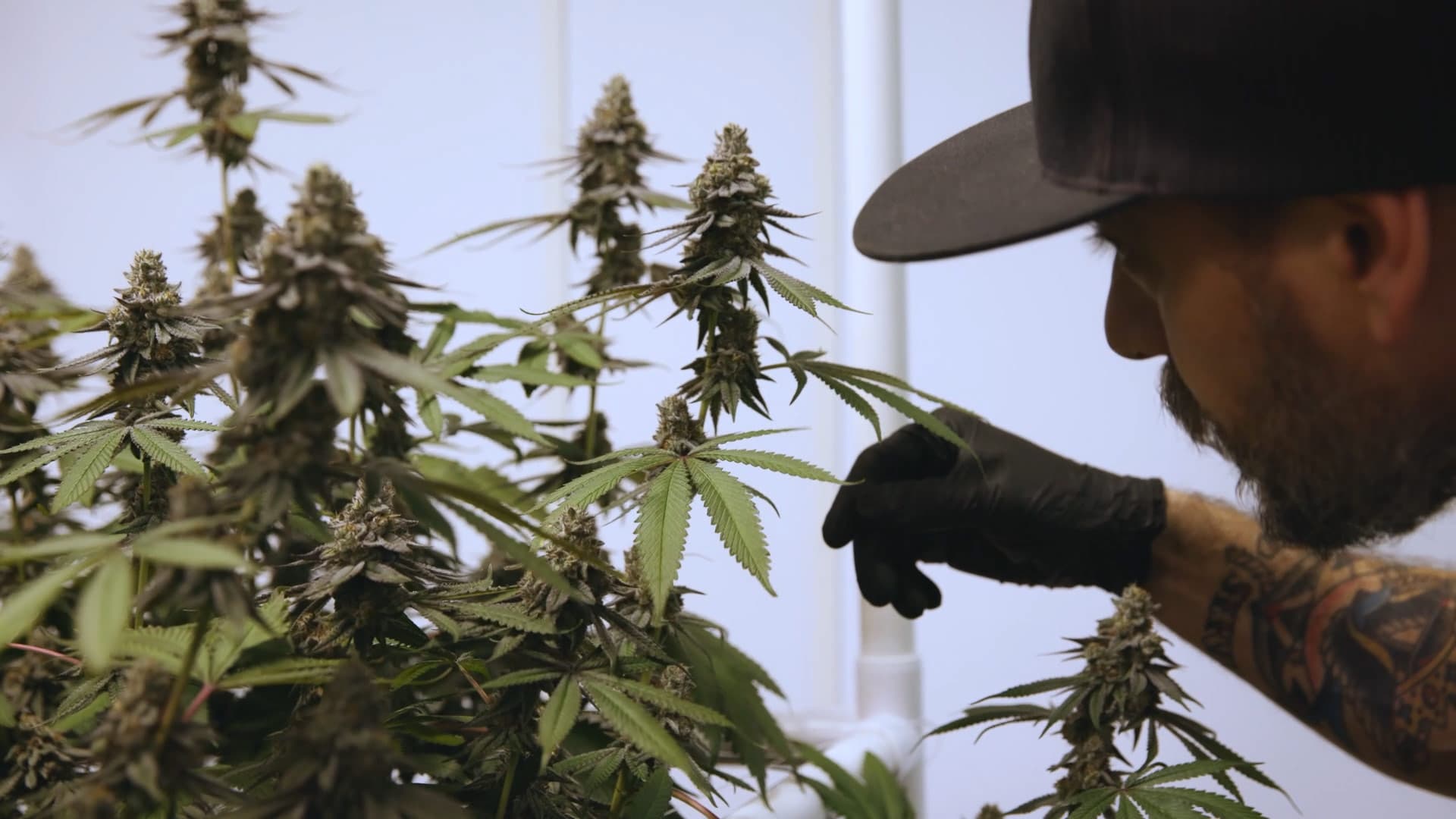
Organic growing closes that door by rule. Synthetic pesticides are simply not allowed, so the question of residue never starts. Pest pressure gets handled biologically instead: beneficial insects, healthy soil, and crop management rather than a spray tank. On our farm, the pest-control crew is ladybugs and lacewings, not a chemical schedule.
Then there are PGRs, the part of conventional growing few brands mention. Plant growth regulators like paclobutrazol and daminozide make plants denser and heavier for market. Daminozide breaks down into a compound the EPA flagged as a probable human carcinogen, and it has been banned on food crops since 1989. Organic certification prohibits these outright. If you want to know how clean cultivation actually works start to finish, read how THCA flower is made and grown, and for adulteration red flags, see whether THCA flower is sprayed.
Difference 2: What You Actually Inhale When You Light It
This is the difference that matters most, and the one almost no potency-focused buyer thinks about. When you smoke contaminated flower, you don’t avoid the residue, you inhale a large share of it. A 2013 study in the Journal of Toxicology measured how much pesticide carried into mainstream smoke and recovered up to 69.5% of the residue through an unfiltered glass pipe (Sullivan et al., Journal of Toxicology, 2013).
The device mattered, but not enough to relax. A water pipe still transferred around 60%, and only a particle filter pulled it down near 11%. Most people smoke flower through unfiltered pipes and joints, which sit at the high end of that range. Whatever the crop carried, a majority of it can ride the smoke into your lungs.
It gets sharper with certain chemicals. Myclobutanil, a fungicide found on a lot of conventional cannabis, can degrade into hydrogen cyanide when burned. Lab testing by Steep Hill flagged hazardous myclobutanil levels in more than 65% of the California samples it screened and noted that exact combustion problem (Steep Hill, via Cannabis Business Times).
Unique Insight
Here’s the honest framing, and the one that actually settles the comparison. The debate over exactly how dangerous any single residue is when smoked will run for years. Organic side-steps the entire argument. If a synthetic fungicide was never applied, there is no residue to transfer, no combustion byproduct to measure, and no panel to fail. You can’t inhale what was never there. That is the cleanest difference between the two flowers, and it’s decided in the soil, not the lab.
Difference 3: What the Plant Pulls Out of the Soil
Cannabis is unusually good at absorbing whatever surrounds its roots. It is a documented bioaccumulator, drawing heavy metals and chemical residues out of soil and concentrating them in its tissue. The effect is measurable in people: a 2023 NHANES analysis found exclusive cannabis users carried roughly 27% higher blood lead and 22% higher blood cadmium than non-users (Environmental Health Perspectives, 2023).
That biology is why soil history matters more for hemp than for almost any other crop. A peer-reviewed 2023 review confirmed industrial hemp readily takes up cadmium, lead, and nickel from contaminated ground (Environmental Science and Pollution Research, 2023). And contamination isn’t rare in finished goods. A 2022 analysis of commercial CBD products detected lead in 42% of samples, mercury in 37%, and arsenic in 28% (Science of the Total Environment, 2022).
Here’s the nuance worth stating plainly: organic certification does not give a plant superpowers to reject metals. What it gives you is documented, audited soil history. The 36-month transition exists precisely so prohibited substances have time to clear before the first certified harvest. With non-organic flower, the soil’s past is a blank you’re asked to trust.
Difference 4: Taste, Terpenes, and the Living-Soil Advantage
Beyond safety, organic and non-organic flower often taste different, and there’s a biological reason. Living, microbe-rich soil supports the plant’s aromatic chemistry. A 2023 meta-analysis across 233 paired observations found that mycorrhizal fungi, the root-partner networks that thrive in organic soils, raised terpenoid content in medicinal plants by 53% on average (meta-analysis, PMC, 2023).
Genetics still set the ceiling for any strain’s aroma. Soil biology decides how close the plant gets to it. Synthetic salt feeding and harsh chemical inputs suppress the fungal networks that organic growing protects, so a chemically pushed plant often spends its energy coping instead of expressing. The payoff of clean cultivation shows up as brighter citrus notes, deeper pine, and a smoother burn. We unpack the sensory side further in our look at the top benefits of choosing organic THCA.
Unique Insight
The overlooked part is that terpenes are fragile. They’re volatile compounds, and aggressive chemical residues plus heavy post-harvest handling degrade them. So organic cultivation does two jobs at once: it avoids adding contaminants, and it protects the very molecules that make craft flower smell and taste alive. Clean inputs and good flavor aren’t separate goals. They’re the same goal.
Difference 5: How Each One Proves It
The last difference is trust, and it’s where the two flowers separate most cleanly. Organic THCA flower can be verified by anyone in about two minutes; non-organic relies on you taking a label at its word. That gap matters, because independent testing keeps finding mislabeled product. A 2024 analysis of 48 hemp-derived products found roughly 15% exceeded legal pesticide limits, many with cannabinoid counts that didn’t match their paperwork (ACIL / NORML, 2024).
With the USDA seal, verification is public. Every certified operation appears in the federal Organic Integrity Database, listing the certifying agent, scope, and current status. A non-organic “organically grown” claim has nothing behind it to check. The strongest assurance pairs both layers: certification that audits the whole grow, plus a third-party Certificate of Analysis that tests the finished batch.
Personal Experience
We tell every customer the same thing: don’t take our word for it either. Look us up in the USDA database, and read the public COA for the batch you’re buying. A genuinely certified brand welcomes the check, because the paperwork already exists. A brand that gets vague when you ask for a certificate number has answered the question for you.
Is Organic THCA Flower Worth Paying More For?
Organic THCA flower does cost more, and the reasons are structural: stricter inputs, lower yields, three years of transition before a farm can sell a certified crop, and annual inspection fees. The demand follows anyway. The U.S. organic hemp market is projected to grow from $187.7 million in 2025 to $660.3 million by 2035, a 13.4% compound annual growth rate (Future Market Insights, 2025).
Is the premium justified for you? Reframe what you’re buying. With conventional flower, the lower price reflects a lower bar: no soil-history requirement and no inspection. With certified organic, the extra cost buys a documented chain from clean ground to tested batch. Like organic food, which carries a 20% to 50%-plus premium over conventional, you’re paying for verification, not just a vibe. With 60% of consumers already willing to pay more for organic (OTA / Euromonitor, 2023), most people decide it is.
Want flower you can trace all the way back to the soil, grown on our own USDA Certified Organic farm and backed by a public Certificate of Analysis? That is what NC farm-direct THCA means in practice: one farm, one chain of custody, a COA for every batch. Browse our organic THCA flower →
Frequently Asked Questions
Is organic THCA flower stronger than non-organic?
Not inherently. Potency comes from the strain and THCA percentage, and heated THCA converts to THC at up to an 87.7% ratio either way (Confidence Analytics). What organic growing changes is the inputs: cleaner smoke, protected terpenes, and no synthetic residue, which many users describe as a clearer, smoother experience.
Does the difference really matter if I smoke it?
It matters more, not less. A 2013 Journal of Toxicology study found up to 69.5% of pesticide residue transferred into inhaled smoke through an unfiltered pipe (Sullivan et al.). Combustion carries residue into your lungs, so what was sprayed on non-organic flower is exactly what you breathe.
Why does organic matter more for hemp than other crops?
Hemp is a bioaccumulator that pulls heavy metals and chemical residues from soil into its tissue. A 2023 NHANES analysis found exclusive cannabis users carried about 27% higher blood lead than non-users (Environmental Health Perspectives). Certified organic flower documents a clean, audited soil history that conventional flower does not.
Is “organically grown” the same as USDA Certified Organic THCA flower?
No. “Organically grown” has no federal legal definition and requires no inspection. USDA Organic is a legally protected federal standard with a 36-month land transition and mandatory annual audits. You can confirm any brand’s status free in the USDA Organic Integrity Database in about two minutes.
Is non-organic THCA flower unsafe?
Not automatically, but it carries more risk and less proof. A 2024 investigation found 45 untested pesticides in legal California products (LA Times / WeedWeek), and a 2024 analysis found about 15% of hemp products exceeded pesticide limits (ACIL / NORML). A public COA plus organic certification is the safest combination.
Found this useful? Share it.
Written by
Ben Cerullo
Founder & Master Grower · Pure Roots Botanicals
Ben Cerullo founded Pure Roots Botanicals after years in organic agriculture, driven by a belief that hemp consumers deserve federal-grade transparency. He manages USDA Certified Organic operations at the North Carolina farm (NOP ID: 5561006795) and writes on hemp education, organic certification, and consumer safety.