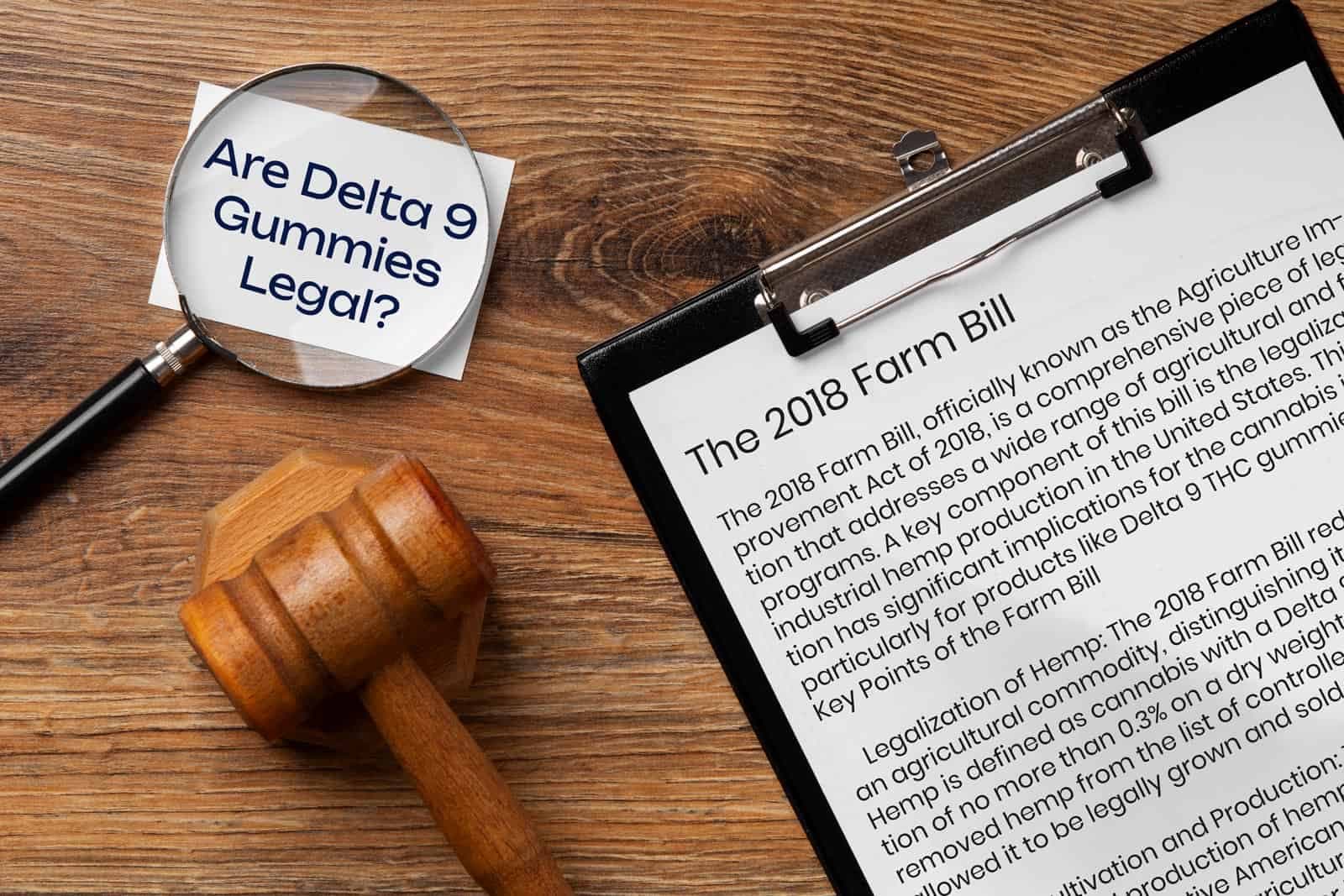
Hemp-derived Delta-9 gummies are legal at the federal level when they are made from hemp and contain no more than 0.3% Delta-9 THC by dry weight, the threshold set by the 2018 Farm Bill (Congressional Research Service, 2025). That single sentence answers the headline question, but it leaves out the part that matters most in 2026: the rules are changing. Below we explain how Delta-9 gummies became legal, what separates them from marijuana products, where Delta-8 fits in, and how to verify that what you are buying is both safe and compliant.
What are Delta 9 THC Gummies?
Delta-9 gummies are edibles infused with Delta-9 tetrahydrocannabinol, the primary intoxicating compound in cannabis. They deliver the same effects as smoking or vaping in a measured, discreet, easy-to-dose format. Because dosing is precise, edibles have become one of the fastest-growing hemp categories, with the broader cannabis edibles market projected to expand sharply through 2035 (Global Market Insights, 2026).
Here is the nuance most labels skip. A gummy weighing a few grams can hold a meaningful dose of Delta-9 and still stay under the 0.3% dry-weight limit, because that percentage is calculated against the total weight of the product, not the THC alone. That math is exactly why compliant hemp Delta-9 gummies can produce a genuine effect while remaining federally legal.
What is the Difference Between Marijuana and Hemp Derived Delta 9 Gummies?
Chemically, there is no difference. Delta-9 THC is one molecule, and your body cannot tell whether it came from a hemp plant or a marijuana plant. The effects are identical. What differs is the legal source. Hemp-derived Delta-9 is federally legal below the 0.3% threshold, while marijuana-derived Delta-9 remains a Schedule I substance under federal law and is legal only in states that have authorized adult-use or medical cannabis.
| Product | THC Limit | Federal Status | Source |
|---|---|---|---|
| Hemp-derived Delta-9 | ≤0.3% Delta-9 by dry weight | Federally legal (2018 Farm Bill) | Naturally extracted from hemp |
| Marijuana-derived Delta-9 | No federal THC ceiling | Federal Schedule I; legal only in adult-use/medical states | Extracted from marijuana |
Delta-8 vs. Delta-9: Understanding the Differences
If you research Delta-9, you will quickly run into Delta-8 THC. It is a close chemical cousin with a similar structure and a noticeably milder, less intense effect. The catch is in how it is produced. Cannabis contains only trace amounts of Delta-8, so it cannot be extracted directly at scale. Instead, manufacturers convert CBD into Delta-8 through a chemical process using acids and solvents.
That synthetic step is the concern. Poorly controlled Delta-8 production can leave behind residual solvents, acids, or heavy metals in the finished product. This is the core reason Pure Roots Botanicals has never made a Delta-8 product. We work only with cannabinoids that occur naturally in the plant we grow.
Delta-8 has historically relied on the same 0.3% Delta-9 hemp threshold for its legal footing, but that footing is far less stable. More than 20 states have already banned or tightly restricted Delta-8, and the upcoming 2026 federal redefinition of hemp folds Delta-8 and other isomers into a single "total THC" standard (Congressional Research Service, 2025).
| Factor | Delta-8 THC | Delta-9 THC |
|---|---|---|
| Potency | Roughly half to two-thirds of Delta-9 per mg | Full strength reference cannabinoid |
| How it is made | Typically converted from CBD using acids and solvents | Naturally present; extracted directly |
| Common side effects | Milder head-high; less reported anxiety | Stronger; high doses can trigger anxiety |
| Regulatory footing | Restricted or banned in 20+ states | Legal where ≤0.3% Delta-9 hemp is allowed |
Federal Law: The Farm Bill
The 2018 Farm Bill (the Agriculture Improvement Act of 2018) legalized hemp and its derivatives at the federal level, defining hemp as cannabis containing no more than 0.3% Delta-9 THC by dry weight (Congressional Research Service, 2025). Everything above that line stayed under the Controlled Substances Act. Everything at or below it, including compliant Delta-9 gummies, became lawful to produce and sell federally.
That same bill handed states the power to regulate hemp within their borders. The result is a patchwork. Some states mirror federal law and allow hemp Delta-9 freely. Others have restricted, taxed, or banned it outright, and rules can shift at the county level. Before buying, it is worth checking your state's current cannabis policy through a resource like the NORML state law map.
One major change is now on the calendar. On November 12, 2025, Congress passed and the President signed H.R. 5371, which rewrites the federal definition of hemp. The new language caps finished hemp products at 0.4 milligrams of total THC per container and counts all intoxicating cannabinoids, not just Delta-9. The provision was set to take effect a year later (Akerman LLP, 2025). On September 2, 2026, a second law, H.R. 6500, moved the start date to December 11, 2026 for naturally occurring cannabinoids such as hemp-derived Delta-9.
What does this mean for you as a buyer right now? Until December 11, 2026, compliant hemp Delta-9 gummies remain federally legal. After the new definition takes effect, the market is expected to shift significantly. We are watching the rules closely and will keep our customers informed as the picture develops.
How to Choose the Best Delta 9 Gummies?
Not all Delta-9 gummies are equal, and the gap is not just about flavor. A 2025 industry audit found that 74% of hemp edibles failed basic testing standards, meaning the potency did not match the label, the safety panel was incomplete, or both (Health Data Consortium, 2026). Underdosed, overdosed, or contaminated products are a real risk, so choosing carefully matters.
To find gummies you can actually trust, look for products that are:
- Made with organic hemp: there is no substitute for clean sourcing. Look for a USDA Certified Organic hemp company, since hemp is a bioaccumulator that draws contaminants from soil into its tissue. Certified organic land has documented clean soil history.
- Third-party lab tested with a public COA: independent lab reports should confirm potency and screen for pesticides, heavy metals, residual solvents, and mold. If a brand will not share its Certificate of Analysis, treat that as your answer.
- Made with live rosin: solventless live rosin from organic flower preserves the plant's full cannabinoid and terpene profile without the solvents used in distillate-based gummies.
Pure Roots Botanicals gummies are made with USDA Certified Organic live rosin from hemp we grow ourselves in North Carolina, and every batch ships with a public lab report. You can browse our Delta-9 gummies here.
Are hemp-derived Delta-9 gummies legal right now?
Yes. As of 2026, hemp-derived Delta-9 gummies are federally legal when the finished product contains no more than 0.3% Delta-9 THC by dry weight under the 2018 Farm Bill. State laws vary, and a new federal definition capping total THC at 0.4 mg per container takes effect December 11, 2026.
Will Delta-9 gummies be illegal after December 11, 2026?
The November 2025 federal law (H.R. 5371) redefines hemp around a 0.4 mg total-THC-per-container limit. A September 2026 law (H.R. 6500) set the start date for Delta-9 and other naturally occurring cannabinoids at December 11, 2026. The U.S. Hemp Roundtable estimates over 90% of current consumable hemp products exceed that cap, so the market is expected to change substantially unless Congress amends the provision.
Do hemp Delta-9 gummies get you high?
Yes. Delta-9 from hemp is the same molecule as Delta-9 from marijuana and produces the same effects. Because the 0.3% limit is measured against total product weight, a compliant gummy can still deliver a meaningful dose of THC.
How can I tell if a Delta-9 gummy is safe and compliant?
Check for a current third-party Certificate of Analysis confirming potency and screening for pesticides, heavy metals, solvents, and mold. A 2025 audit found 74% of hemp edibles failed basic testing standards, so verified lab results from organic-sourced products are the best safeguard.
Found this useful? Share it.
Written by
Ben Cerullo
Founder & Master Grower · Pure Roots Botanicals
Ben Cerullo founded Pure Roots Botanicals after years in organic agriculture, driven by a belief that hemp consumers deserve federal-grade transparency. He manages USDA Certified Organic operations at the North Carolina farm (NOP ID: 5561006795) and writes on hemp education, organic certification, and consumer safety.